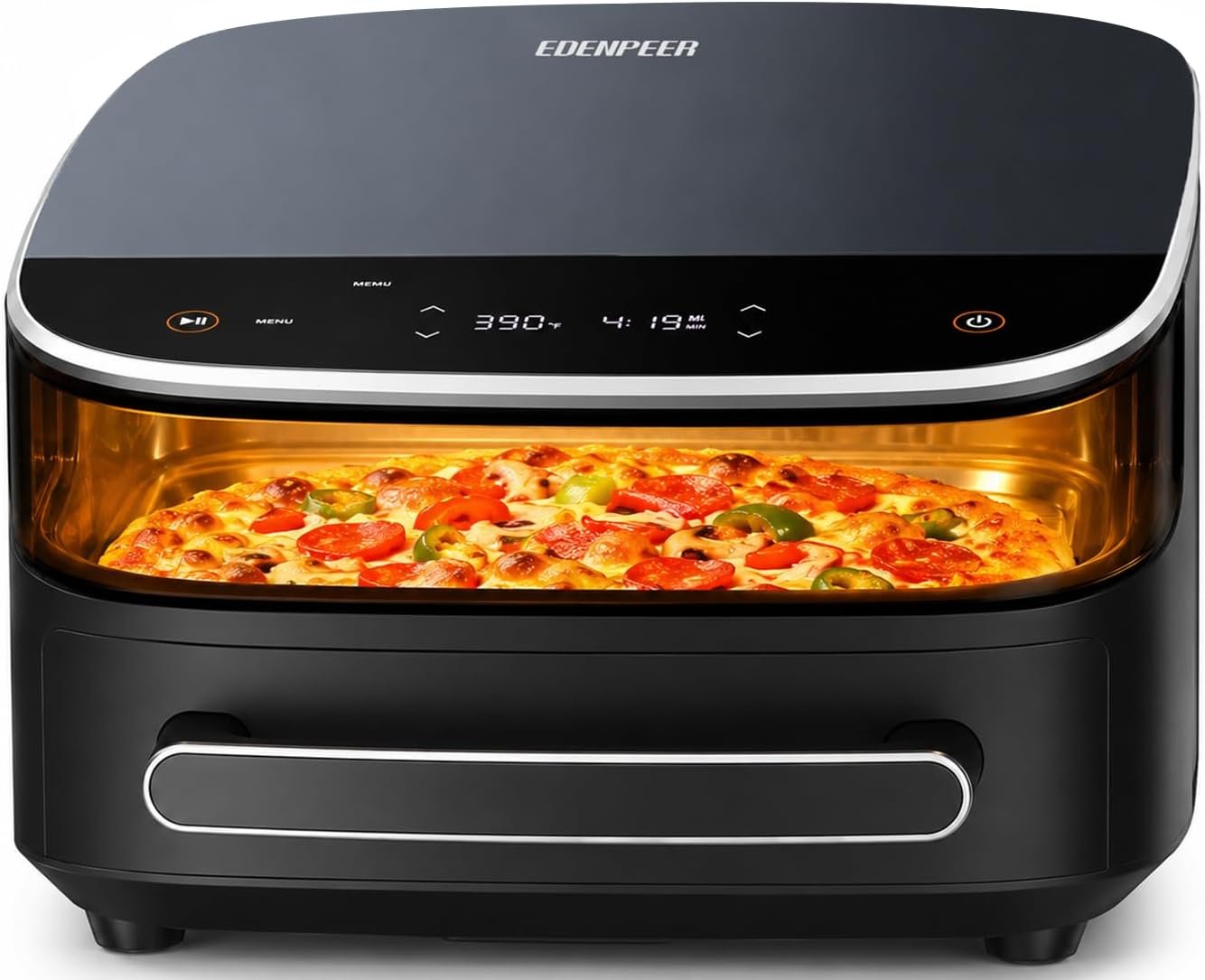
Air fryers have evolved considerably beyond the simple basket appliances that first became popular for preparing fries and frozen snacks. Today, some models are designed with larger cooking areas, multiple heating elements, viewing windows, digital controls, and several cooking modes intended to handle different types of meals.
The 6QT Large Air Fryer with 11-in-1 cooking functions takes a somewhat different approach from many conventional basket-style air fryers. Instead of relying primarily on a heating element positioned above the food, this model uses a dual-heat-source design with heating from both the top and bottom. The goal is to distribute heat more directly throughout the cooking chamber and reduce the need to manually turn or flip certain foods during preparation.
The appliance has a 6-quart cooking capacity and is designed with a relatively wide, flat cooking area. Product information indicates that the cooking surface can accommodate foods such as a pizza measuring up to 12 inches, depending on the specific arrangement and cookware used. It also includes a 270-degree viewing window with interior lighting, allowing food to be monitored without repeatedly opening the cooking chamber.
Another notable feature is its 11-in-1 functionality. Rather than being limited to air frying, the appliance is designed for several cooking applications, including air frying, roasting, baking, broiling, reheating, and dehydrating. Product specifications identify it as a digital, touch-controlled appliance with a 6-quart capacity, 1,700 watts of power, a temperature range of approximately 100°F to 445°F, and dishwasher-safe components.
This guide looks at how the 6QT air fryer works, what its major features mean in everyday cooking, the types of foods it may be useful for, and the factors worth considering before adding a large countertop air fryer to a kitchen.
Key Features
6-Quart Cooking Capacity
The 6-quart capacity places this appliance in the medium-to-large household air fryer category.
Capacity is important because it affects how much food can potentially be prepared in a cooking cycle. A larger cooking chamber can be useful for family meals, meal preparation, or occasions when several portions need to be cooked without relying on a very small basket.
However, a stated capacity should not be interpreted as an instruction to fill the cooking area completely.
Air frying depends on the movement of hot air around food. Some ingredients need additional space between pieces to encourage browning and allow heated air to reach more surfaces. As a result, the practical amount of food that can be cooked effectively will depend on the recipe and the shape of the ingredients.
The relatively wide design of this model is also worth noting. Instead of focusing on a deep, narrow basket, the appliance uses a flatter cooking area. This can be useful for foods that are easier to arrange across a surface rather than pile vertically.
Product information specifically describes the cooking area as large enough for a 12-inch pizza, although users should always verify the dimensions of their cookware and the appliance’s instructions before placing a particular dish inside.
Top and Bottom Heating
The most distinctive feature of this air fryer is its dual heating system.
Traditional air fryers commonly position their primary heating element above the cooking chamber and circulate hot air downward and around the food. A dual-heating design adds a second heat source underneath the cooking area.
The idea is relatively straightforward: heat is introduced from both directions rather than primarily from one side.
This can be particularly useful for foods that traditionally require flipping or turning during cooking. With heat being supplied from above and below, certain foods can potentially receive more direct exposure to heat on both surfaces.
That does not mean every recipe will always cook perfectly without intervention. Food thickness, moisture content, quantity, positioning, and recipe design can all influence cooking. The “no flip needed” concept is therefore better understood as a design objective rather than a universal rule for every ingredient.
For flat foods such as pizza, patties, breaded items, or certain vegetables, the dual-heating configuration can be especially relevant.
11-in-1 Cooking Functionality
The appliance is marketed as an 11-in-1 air fryer, providing several cooking options within one countertop unit.
Available product information identifies applications including:
- Air frying
- Roasting
- Baking
- Broiling
- Reheating
- Dehydrating
The exact organization of the 11 programs may vary depending on the control interface and product configuration, so users should consult the included instructions for the complete program list.
Having multiple cooking modes can make an appliance more flexible for everyday meals.
For example, air frying may be appropriate for potatoes or breaded foods, while baking can be used for smaller baked dishes. Reheating can be useful for leftovers, roasting can handle vegetables or meats, and dehydration provides a lower-temperature option for drying suitable foods.
This multifunction design can therefore reduce the need to switch between different countertop appliances for relatively small cooking tasks.
1,700-Watt Power
The available product specifications list the air fryer at 1,700 watts and 120 volts.
Wattage describes the electrical power the appliance is designed to use while operating. A higher-power countertop appliance can support strong heating performance, but actual cooking speed also depends on the heating system, airflow, food quantity, starting temperature, and selected program.
It is also important to consider electrical requirements when using a 1,700-watt appliance.
The unit should be connected according to the manufacturer’s electrical instructions and used with a suitable household outlet. Avoid assuming that any extension cord or power strip is appropriate for a high-powered kitchen appliance.
Temperature Range
The product specifications indicate a minimum temperature of approximately 100°F and a maximum setting of approximately 445°F.
This provides a broad operating range.
Higher temperatures can be useful for applications where browning and crisping are desired. Lower temperatures are more appropriate for gentler cooking or dehydration.
Having a broad range does not mean every recipe should be prepared at the highest temperature. In practice, the correct setting depends on the ingredients, their size, and the selected cooking function.
Recipes should be treated as starting points, particularly when moving from a conventional oven to an air fryer.
270-Degree Viewing Window
Another useful design feature is the large viewing area.
The product information describes a 270-degree viewing window with interior lighting.
This allows users to observe the food during cooking without opening the appliance simply to check its appearance.
Being able to see food can be helpful when preparing ingredients that brown quickly. Instead of relying exclusively on a timer, users can observe changes in color and texture through the window.
The viewing window can also be useful when experimenting with unfamiliar recipes because cooking times can vary depending on the quantity and preparation method.
Digital Touch Controls
The appliance uses digital touch controls rather than a traditional mechanical dial system. Product specifications identify the control method as touch-based.
Digital controls can make it easier to select cooking modes and adjust time or temperature.
For people who frequently prepare different types of food, having dedicated programs can also reduce the need to manually determine every cooking parameter.
However, preset programs should not be treated as universal settings. A preset is a convenient starting point, while the actual cooking process still depends on the food being prepared.
Quiet Operation
Product information lists the operating noise level at approximately 50 decibels.
Noise can matter in kitchens connected to living areas, apartments, or homes where cooking takes place early in the morning or later in the evening.
The actual perceived sound can vary depending on the surrounding environment and the operating condition of the appliance.
A fan-based cooking appliance will naturally produce some airflow and motor noise, but a specified noise level gives consumers another characteristic to consider when comparing countertop cooking equipment.
Dishwasher-Safe Components
The available specifications identify the product as dishwasher safe.
Ease of cleaning is an important consideration with any air fryer because grease, crumbs, and food residue can accumulate during regular use.
Dishwasher compatibility can simplify routine maintenance, but users should still follow the manufacturer’s cleaning instructions. Not every component necessarily needs to be washed in the same way, and electrical components should never be immersed in water.
Regular cleaning can also help prevent accumulated grease and food particles from affecting future cooking cycles.
How It Can Be Used
A multifunction air fryer becomes more useful when its different cooking modes are matched to everyday meals.
Air Frying Potatoes and Frozen Foods
Potatoes are one of the most common air-fryer applications.
The 6QT cooking area can be used for foods such as:
- French fries
- Potato wedges
- Tater tots
- Hash browns
- Sweet potato fries
- Frozen potato snacks
The dual-heating configuration is particularly relevant for foods that traditionally need turning or shaking.
Even so, users should follow the specific recipe or package instructions. Some foods may still benefit from redistribution during cooking, particularly when the cooking surface is crowded.
Frozen foods can also be convenient because many products can go directly from the freezer into the air fryer.
The exact cooking time will depend on the food’s thickness, quantity, and formulation.
Preparing Chicken
Chicken is another practical application.
Chicken wings, tenders, thighs, drumsticks, and smaller chicken portions can all be suitable for air-fryer cooking when prepared according to appropriate food-safety guidance.
The top-and-bottom heating design may help expose both sides of the food to heat.
However, chicken should always be evaluated based on safe internal temperature rather than exterior color alone.
Thicker pieces can brown on the outside while still requiring additional cooking in the center. A food thermometer can therefore be useful when preparing poultry.
Cooking Steak
The product’s relatively broad cooking area can also be used for steak and other individual cuts of meat.
The high-temperature capability can support browning, while the dual heating system provides heat from both directions.
Steak thickness, starting temperature, desired doneness, and preparation method all influence cooking time.
Rather than depending on a fixed number of minutes, users should consider internal temperature when determining whether a steak has reached the desired level of doneness.
Preparing Fish and Seafood
Fish fillets can be convenient to prepare in a countertop air fryer.
The circulating hot air can cook fish relatively quickly, while the broad cooking surface can provide space for individual portions.
Because fish is delicate, avoid automatically using the highest temperature. A moderate temperature may provide more control depending on the recipe.
The viewing window can also be useful for monitoring delicate foods without opening the appliance repeatedly.
Roasting Vegetables
The appliance can be used for roasting vegetables such as:
- Broccoli
- Cauliflower
- Brussels sprouts
- Zucchini
- Bell peppers
- Carrots
- Asparagus
- Green beans
- Sweet potatoes
A light coating of oil and seasoning can be applied before cooking.
Vegetables should ideally be cut into reasonably consistent pieces so they cook at a similar rate.
The cooking surface should not be unnecessarily crowded because excess moisture and limited airflow can influence browning.
Reheating Leftovers
The reheat function is useful for leftover foods that benefit from hot circulating air.
Pizza, roasted potatoes, chicken pieces, breaded foods, and roasted vegetables can often be reheated in an air fryer.
Compared with some reheating methods, hot-air circulation can help restore some surface texture.
A lower temperature is often a reasonable starting point for reheating because the objective is to warm the food without unnecessarily drying the exterior.
Baking
The appliance can also serve as a compact baking environment.
Depending on the available space and compatible cookware, users may prepare:
- Small cakes
- Muffins
- Brownies
- Cookies
- Baked oats
- Small casseroles
- Individual desserts
The flatter cooking chamber can be useful for certain shallow baking dishes.
However, air-fryer baking differs from conventional oven baking because the air moves more rapidly around the food. Recipes may therefore require adjustments in temperature and cooking time.
Broiling
Broiling uses high heat to brown the surface of food.
This can be useful for finishing certain dishes or adding additional color toward the end of cooking.
Because broiling can brown food quickly, it is important to monitor the cooking process carefully.
The viewing window provides an opportunity to observe the food without repeatedly opening the cooking chamber.
Dehydrating
Dehydration is another application made possible by the lower end of the appliance’s temperature range.
Suitable foods can include:
- Apple slices
- Banana slices
- Mango
- Strawberries
- Herbs
- Vegetable slices
- Certain homemade snacks
Dehydration generally takes much longer than ordinary air frying.
Food should be sliced consistently and arranged so that air can move around it.
When dehydrating meat, additional food-safety precautions are necessary. Homemade jerky should be prepared using a reliable food-safety method rather than relying solely on the air fryer’s temperature setting.
Cooking Pizza
One of the more distinctive aspects of the wide cooking area is its stated ability to accommodate a pizza measuring up to 12 inches.
This can be useful for reheating or preparing certain pizzas.
The actual fit will depend on the pizza’s shape, thickness, and the dimensions of the usable cooking surface.
A large cooking area can also be helpful when preparing flat foods that benefit from being arranged in a single layer.
Who It May Be Suitable For
Families
A 6-quart cooking area can make sense for households that regularly prepare meals for several people.
It provides more room than many compact air fryers without moving into the much larger physical footprint of some countertop oven-style appliances.
Families may find the format useful for preparing chicken, vegetables, potatoes, and frozen foods.
Meal Preparation
The broad cooking surface can be useful for people who prepare several portions at once.
For example, a user might roast vegetables while preparing chicken or potatoes in another cooking appliance.
The air fryer can also be useful for preparing multiple portions of the same food.
However, meal preparation still needs to account for food spacing. A larger capacity is helpful, but overcrowding can reduce airflow.
People Who Prefer Minimal Food Handling
The dual-heating system may appeal to people who would rather not repeatedly flip food.
Traditional air frying sometimes involves shaking a basket or turning larger pieces halfway through cooking.
Because this model introduces heat from both above and below, certain foods may require less manual intervention.
The “no flip needed” concept should still be applied sensibly. Food that is particularly thick, irregularly shaped, or crowded may still benefit from checking or repositioning.
People Who Want Multiple Cooking Modes
A person looking for an appliance that can handle several countertop cooking tasks may appreciate the 11-in-1 format.
Instead of purchasing separate equipment for reheating, roasting, baking, and dehydrating, a multifunction air fryer can provide several of these capabilities in one appliance.
That said, specialized appliances can still have advantages for specific tasks. The right choice depends on what a household actually cooks.
Kitchens Where Monitoring Food Is Important
The large viewing window can be useful for people who like to observe food during cooking.
This is especially relevant when learning a new recipe or preparing foods that can move quickly from lightly browned to over-browned.
The interior lighting further improves visibility inside the cooking chamber.
Important Things to Consider
Measure the Countertop Area
The appliance is relatively wide and deep compared with compact basket air fryers.
Available specifications list dimensions of approximately 18.23 inches deep, 14.8 inches wide, and 8.37 inches high.
That low height is useful for some kitchen layouts, but the depth and width should be checked carefully before placing the appliance on a countertop.
Measure the available space and consider the clearance required around the appliance according to its instructions.
Consider the 120-Volt Electrical Requirement
The product specifications identify a 120-volt electrical system and 1,700-watt output.
This is particularly important for anyone purchasing the appliance from a different country.
Electrical voltage and plug compatibility should be verified before use. A U.S.-market appliance should not simply be connected to an incompatible electrical system.
Understand the Difference Between Capacity and Usable Space
A 6-quart capacity does not mean six quarts of food can be loaded into the cooking chamber without affecting airflow.
The practical amount depends on the food.
French fries, vegetables, and small pieces of chicken often benefit from being spread across the cooking surface. Large pieces may occupy more physical space even though they contain less volume.
Don’t Assume Every Food Requires No Flipping
The dual-heating system is intended to reduce the need for flipping, but cooking results depend on the food.
Very thick foods, irregularly shaped ingredients, or heavily crowded cooking surfaces may still benefit from turning or repositioning.
The “no flip” feature is therefore most useful when understood as a way of reducing manual intervention for suitable foods rather than a guarantee that every recipe requires no attention.
Monitor High-Temperature Cooking
The appliance reaches approximately 445°F according to available product specifications.
At high temperatures, food can brown quickly.
The viewing window makes visual monitoring easier, but users should still follow appropriate cooking instructions and avoid leaving food unattended when the recipe requires closer supervision.
Use Suitable Cookware
If using baking dishes, pans, or other accessories inside the appliance, verify that they are appropriate for the available cooking space and temperature range.
A dish that is technically heat resistant may still restrict airflow if it covers too much of the cooking surface.
Proper airflow is an important part of air-fryer cooking.
Cleaning Matters
Air fryers can accumulate grease and food particles during regular use.
Even if components are dishwasher safe, the appliance should be cleaned regularly according to the manufacturer’s instructions.
The interior electrical components should not be submerged in water.
The heating areas should also be allowed to cool before cleaning.
Food Safety Still Applies
Air frying is a cooking method, not a replacement for food-safety practices.
Raw meat, poultry, and seafood should reach appropriate internal temperatures.
Perishable leftovers should also be refrigerated promptly and reheated safely.
For dehydration, especially when preparing meat, users should follow established food-safety guidance rather than relying only on the appliance’s timer.
Comparison of General Air Fryer Categories
The 6QT dual-heating air fryer belongs to a broader category of countertop cooking appliances. Understanding the differences between common formats can make it easier to determine what type of appliance fits a particular kitchen.
Compact Basket Air Fryers
Compact models generally prioritize a small footprint.
They can be useful for individuals or households that cook smaller portions and have limited countertop space.
The tradeoff is that larger meals may require multiple batches.
The 6-quart model takes a different approach by emphasizing a larger cooking surface.
Standard Single-Heating Basket Air Fryers
Many conventional air fryers use a heating element positioned above the cooking basket and a fan to circulate hot air.
They can be simple and practical for everyday air frying.
The dual-heating model adds a lower heat source, which changes the way heat is delivered to the food.
This can be particularly relevant for users who want to reduce the amount of flipping or turning required for certain foods.
Dual-Basket Air Fryers
Dual-basket models divide the cooking space into two separate compartments.
This can be useful when preparing two foods at different temperatures or cooking times.
The 6QT model instead provides one larger cooking area.
That makes it more appropriate for users who prefer a single broad surface rather than independent cooking zones.
Air Fryer Toaster Ovens
Air fryer toaster ovens generally use a larger rectangular chamber with racks and trays.
They can be useful for toast, larger baking dishes, pizzas, and foods that need more vertical space.
The 6QT flat air fryer is more specialized around a broad, relatively shallow cooking surface.
This design may be useful for pizza, steaks, vegetables, and other foods that can benefit from horizontal cooking space.
Multifunction Countertop Cookers
Multifunction cookers can combine several technologies such as pressure cooking, slow cooking, steaming, and air frying.
They are designed for households that want several cooking methods in one appliance.
The 6QT air fryer is more focused on convection-style cooking, with its 11-in-1 functions centered around air frying and related applications such as baking, roasting, broiling, reheating, and dehydrating.
Practical Tips for Getting Consistent Results
Arrange Food in a Single Layer When Possible
Food placement can have a major influence on air-fryer cooking.
When ingredients are spread across the cooking surface, more of their surface area is exposed to circulating heat.
This is particularly important for potatoes, vegetables, breaded foods, and smaller pieces of meat.
Cut Ingredients Into Similar Sizes
If vegetables or potatoes are cut into dramatically different sizes, smaller pieces may finish before larger pieces.
Consistent sizing makes it easier to estimate cooking time.
Use a Light Amount of Oil When Appropriate
Air frying generally uses less oil than deep frying, but that does not mean oil can never be used.
A small amount can help seasonings adhere and can influence browning and surface texture.
The appropriate amount depends on the recipe and ingredient.
Avoid Excessive Crowding
Even with a 6-quart capacity, the cooking surface should not automatically be filled to its maximum physical capacity.
If the food is piled too heavily, airflow can become restricted.
Cooking in a smaller batch can sometimes provide more consistent results than trying to prepare everything simultaneously.
Check Food During the First Few Uses
When adapting a conventional recipe, it is useful to observe how quickly the air fryer cooks the food.
The viewing window provides a convenient way to monitor browning.
Once a suitable temperature and time combination has been established for a particular recipe, future batches can become easier to manage.
Use Internal Temperature for Meat
Visual appearance alone is not a reliable way to determine whether meat or poultry is safely cooked.
A food thermometer provides more useful information.
This is especially important with thicker foods, where the outside can brown significantly before the center reaches the appropriate temperature.
Frequently Asked Questions
What is the capacity of this air fryer?
The appliance has a 6-quart cooking capacity. Product information describes it as a family-size air fryer with a relatively large cooking area.
Does it have heating elements on both the top and bottom?
Yes. The product is designed around a dual-heat-source system, with heating from both above and below the cooking area.
Does the air fryer really require no flipping?
The dual-heating design is intended to reduce or eliminate the need for flipping for suitable foods.
However, no-flip cooking should not be interpreted as a guarantee for every recipe. Food thickness, arrangement, quantity, and moisture can all influence cooking.
What temperature does the air fryer reach?
Available product specifications list a maximum temperature of approximately 445°F and a minimum setting of approximately 100°F.
How many cooking functions does it have?
The product is marketed as an 11-in-1 air fryer. Its documented applications include air frying, roasting, baking, broiling, reheating, and dehydrating, with additional programs included within the 11-function system.
Can it fit a 12-inch pizza?
Product information states that the 6-quart cooking area can accommodate a pizza up to 12 inches.
Actual fit can depend on the shape and thickness of the pizza and the usable dimensions of the cooking surface.
Does it have a viewing window?
Yes. The appliance features a 270-degree viewing window along with interior lighting.
Is the air fryer quiet?
Product specifications describe its operating noise level as approximately 50 dB.
Actual perceived noise can vary depending on the room and surrounding sounds.
How much power does it use?
The available specifications list an output of 1,700 watts and a voltage of 120 volts.
Is it dishwasher safe?
Available product specifications state that the appliance is dishwasher safe. Users should consult the supplied care instructions to determine which individual components are suitable for dishwasher cleaning.
Can it dehydrate food?
Yes. Dehydrating is included among the appliance’s cooking applications. Product information lists dehydration as one of its recommended uses.
Can it bake?
Yes. Baking is one of the supported cooking applications.
Small cakes, muffins, brownies, and other suitable baked foods may be prepared when the cookware fits safely inside the cooking chamber.
Can it roast vegetables?
Yes. Roasting is one of the listed recommended uses.
Vegetables can be seasoned and lightly coated with oil before being arranged across the cooking surface.
Can it reheat leftovers?
Yes. Reheating is one of the appliance’s intended uses.
It can be useful for foods where circulating hot air helps maintain or restore some surface texture.
Is the 6-quart capacity suitable for a family?
It can be suitable for family meals, depending on household size and the foods being prepared.
The 6-quart cooking area provides more space than many compact models, although certain foods may still require multiple batches when airflow and spacing are important.
What are the dimensions?
Available specifications list the dimensions at approximately 18.23 inches deep, 14.8 inches wide, and 8.37 inches high.
Measuring the intended countertop location before use is recommended.
What is the advantage of a flat cooking area?
A flatter cooking area provides more horizontal space.
This can be useful for foods such as pizza, steaks, patties, vegetables, and other ingredients that are easier to arrange in a single layer.
Can the appliance replace a conventional oven?
It can perform several tasks that are also possible in an oven, including baking, roasting, and broiling.
However, the cooking chamber is considerably smaller than a conventional oven, so it should be considered a countertop cooking appliance rather than a universal replacement.
Is top-and-bottom heating useful for thicker foods?
It can help provide heat from both directions, which may be useful for certain thicker or flat foods.
However, cooking performance depends on the specific food. Thick ingredients should still be checked for proper internal cooking rather than relying solely on exterior appearance.
Conclusion
The 6QT Large Air Fryer with 11-in-1 functionality takes a somewhat different approach to countertop air frying by combining a broad cooking area with heating elements positioned above and below the food.
Its 6-quart capacity can provide useful space for family meals, meal preparation, vegetables, potatoes, chicken, seafood, steaks, pizza, and other everyday foods. The relatively flat cooking design also makes the appliance interesting for foods that benefit from being arranged across a wide surface rather than stacked in a deep basket.
The dual-heating system is one of its most distinctive characteristics. By introducing heat from both directions, the appliance is designed to reduce the amount of flipping required for appropriate foods. While that can simplify some cooking routines, it is still important to understand that food placement, thickness, quantity, and recipe requirements can influence whether flipping or repositioning is necessary.
Its 11-in-1 format also makes it more versatile than a basic air fryer. Air frying, roasting, baking, broiling, reheating, and dehydrating are among the documented applications, giving users several ways to use the appliance throughout the week.
The 270-degree viewing window and interior lighting add another practical element by making it easier to monitor food during cooking. Meanwhile, the 1,700-watt power rating, digital touch controls, approximately 100°F to 445°F temperature range, and dishwasher-safe design provide additional characteristics to consider when comparing countertop cooking appliances.
As with any air fryer, the most consistent results come from understanding how airflow and cooking space interact. Avoiding unnecessary overcrowding, using appropriately sized ingredients, checking food during unfamiliar recipes, and following food-safety guidance can all contribute to a more predictable cooking process.
For households looking for a large cooking surface and a multifunction countertop appliance, this 6-quart dual-heating format represents one approach to combining air frying with several other cooking tasks.
Leave a Reply