Author: hocineghazouan@gmail.com

  • Air Fryer Cheat Sheet Magnets Booklet: A Practical Guide for Beginners and Everyday Cooking

    Air Fryer Cheat Sheet Magnets Booklet: A Practical Guide for Beginners and Everyday Cooking

    Air fryers have become a familiar appliance in many kitchens, but owning one does not automatically make every cooking decision straightforward. New users often have questions about temperature, cooking time, food preparation, basket capacity, reheating, and safe internal temperatures. Even experienced users may occasionally need a quick reminder when preparing an ingredient they have not cooked before.

    An air fryer cheat sheet booklet can provide a convenient reference for those everyday situations.

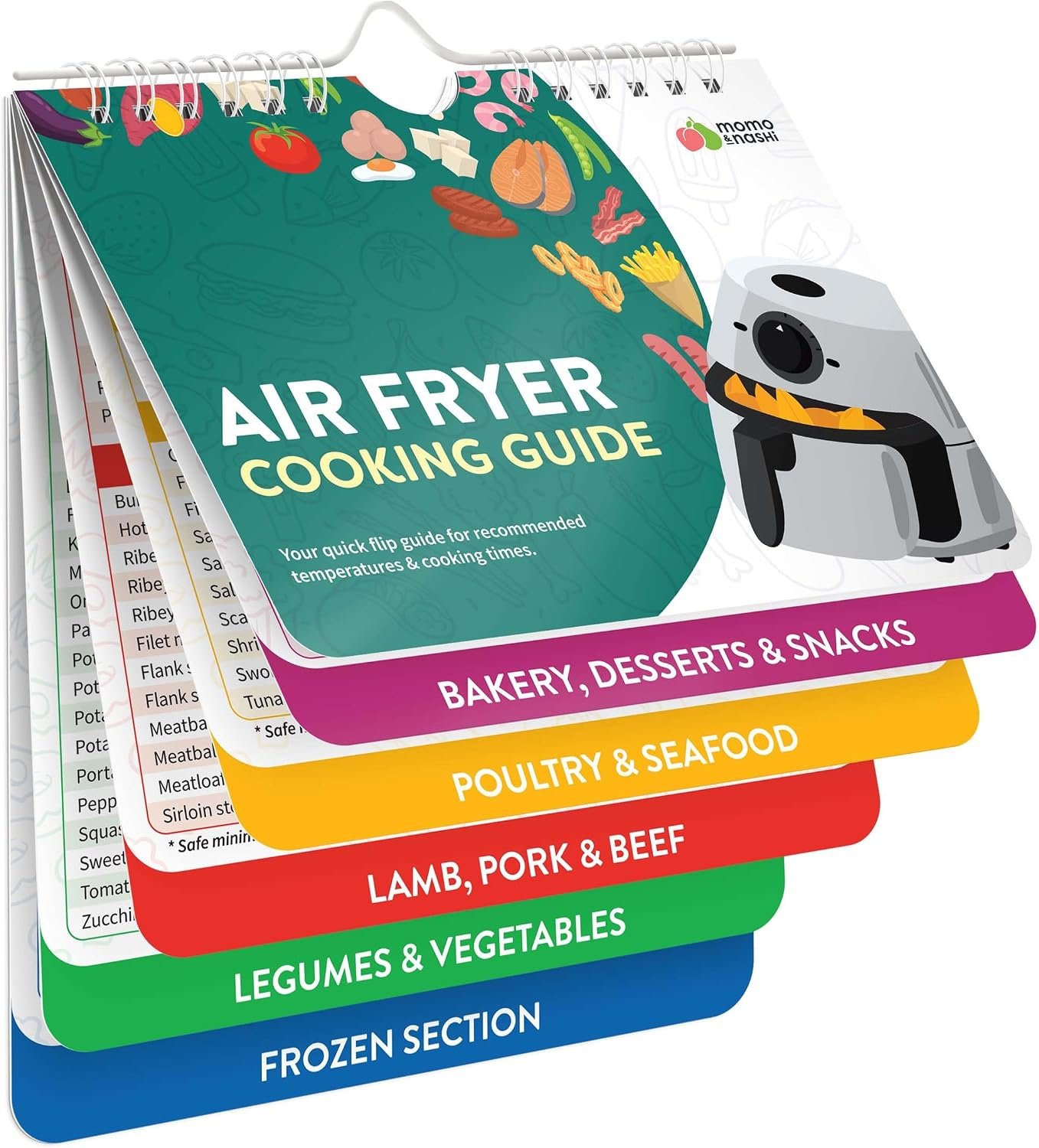
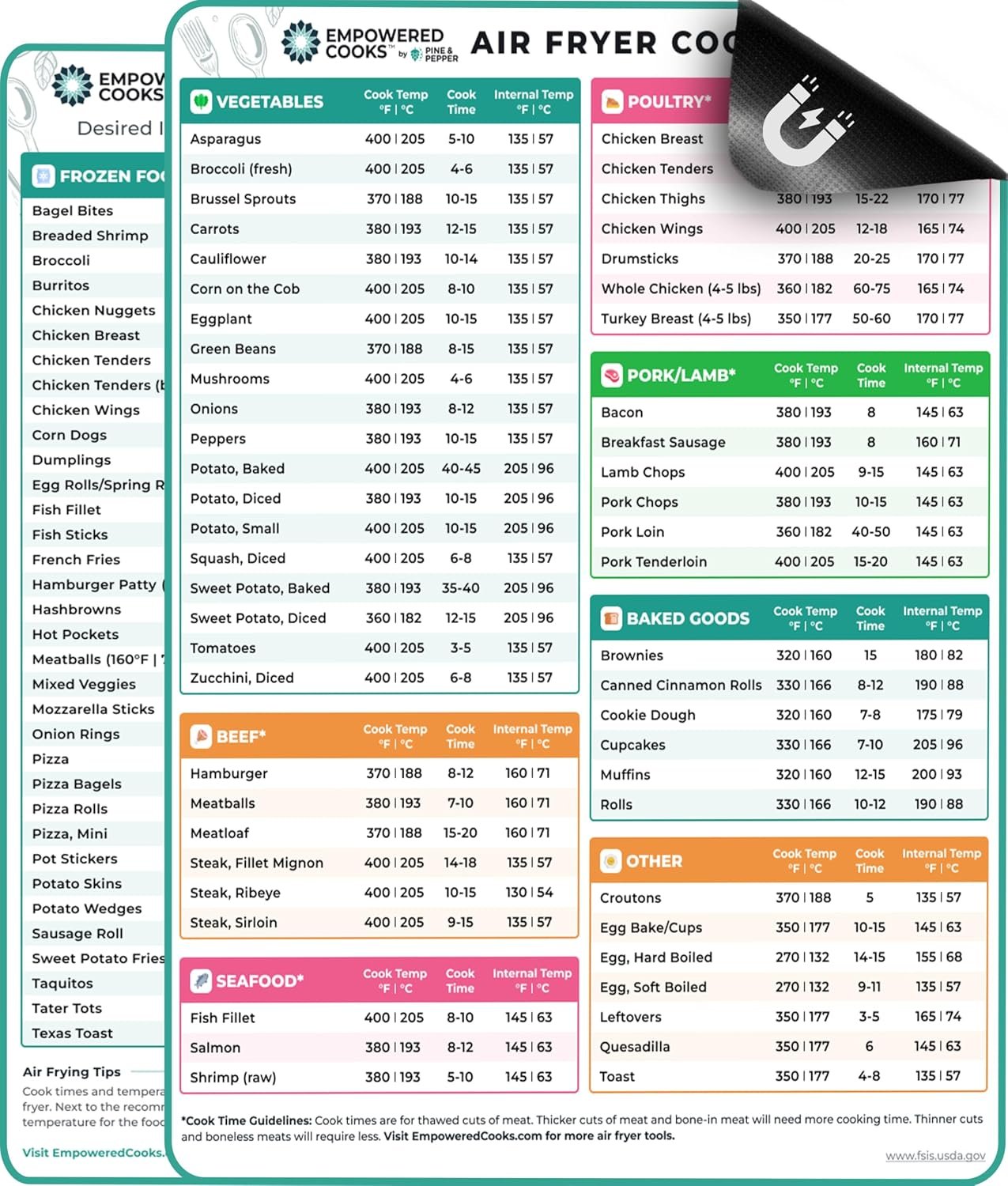
    The Air Fryer Cheat Sheet Magnets Booklet featured in this guide combines quick-reference cooking information with a booklet-style format designed for people who want basic air fryer guidance available in the kitchen. The product is also presented as an air fryer cookbook and cooking guide, with references to air fryer liners and kitchen accessories.

    Rather than functioning as an air fryer itself, this type of product is intended to support the cooking process. It can help users understand general cooking times and temperatures, discover different food ideas, and become more familiar with how air fryer cooking differs from conventional oven preparation.

    The magnetic component is particularly practical for a kitchen environment. A magnetic cooking guide can be placed on a suitable refrigerator or other magnetic surface, making frequently used information easier to access while preparing meals.

    For beginners, having a physical guide can reduce some of the uncertainty that comes with learning a new appliance. Instead of searching online every time a common ingredient needs to be prepared, a user can consult a quick-reference guide and then adjust the cooking process based on the particular air fryer and food.

    However, cooking charts should always be viewed as starting points rather than exact guarantees. Air fryers differ in capacity, wattage, airflow, heating elements, basket shape, and temperature behavior. Ingredients also vary in size, thickness, moisture, and starting temperature.

    This article explores the purpose of an air fryer cheat sheet booklet, the types of information it can provide, practical ways to use it, who may benefit from this kind of kitchen accessory, and important considerations when relying on cooking charts and guides.

    Key Features

    Magnetic Air Fryer Reference Format

    One of the main characteristics of the product is its magnetic reference format.

    A magnetic cooking guide can be placed somewhere convenient in the kitchen rather than stored inside a drawer or cabinet.

    Common placement options may include:

    • Refrigerator doors
    • Magnetic appliance surfaces
    • Magnetic kitchen boards
    • Other suitable metal surfaces

    The goal is accessibility.

    When preparing food, a user can look at the guide without opening a cookbook or searching through a phone.

    This can be particularly convenient for simple meals where the main question is something like, “What temperature should I use?” or “How long should this food cook?”

    The magnetic format also makes the guide easy to reposition if the kitchen setup changes.

    Booklet-Style Cooking Information

    The product combines the concept of a cheat sheet with a booklet.

    This provides a different experience from a single small cooking chart.

    A compact reference can provide quick information, while a booklet can offer additional context and cooking ideas.

    For someone who is still learning how to use an air fryer, having more than a single list of temperatures can be helpful.

    A beginner may need guidance on cooking basic foods, while an experienced user may simply use the information as a reminder.

    The booklet format can therefore bridge the gap between a full cookbook and a simple temperature chart.

    Air Fryer Cooking Guide

    An air fryer cooking guide is primarily useful for establishing starting points.

    Air frying uses circulating heated air, which can cook food differently from conventional oven or stovetop methods.

    A guide can help users become familiar with typical temperature ranges and cooking durations for common ingredients.

    Instead of approaching every food as a completely new experiment, users have a reference point from which to begin.

    This can make the learning process more structured.

    Cookbook Elements for Beginners

    The product is also described as an air fryer cookbook for beginners.

    A beginner-oriented cookbook typically focuses on approachable meals and straightforward preparation rather than highly technical cooking techniques.

    This type of resource can be useful for someone who has recently purchased an air fryer and wants ideas beyond frozen fries and chicken nuggets.

    Potential recipe categories can include:

    • Breakfast foods
    • Vegetables
    • Potatoes
    • Chicken
    • Meat
    • Seafood
    • Snacks
    • Side dishes
    • Desserts
    • Reheated foods

    The exact recipe selection should be checked against the current Amazon listing or product contents.

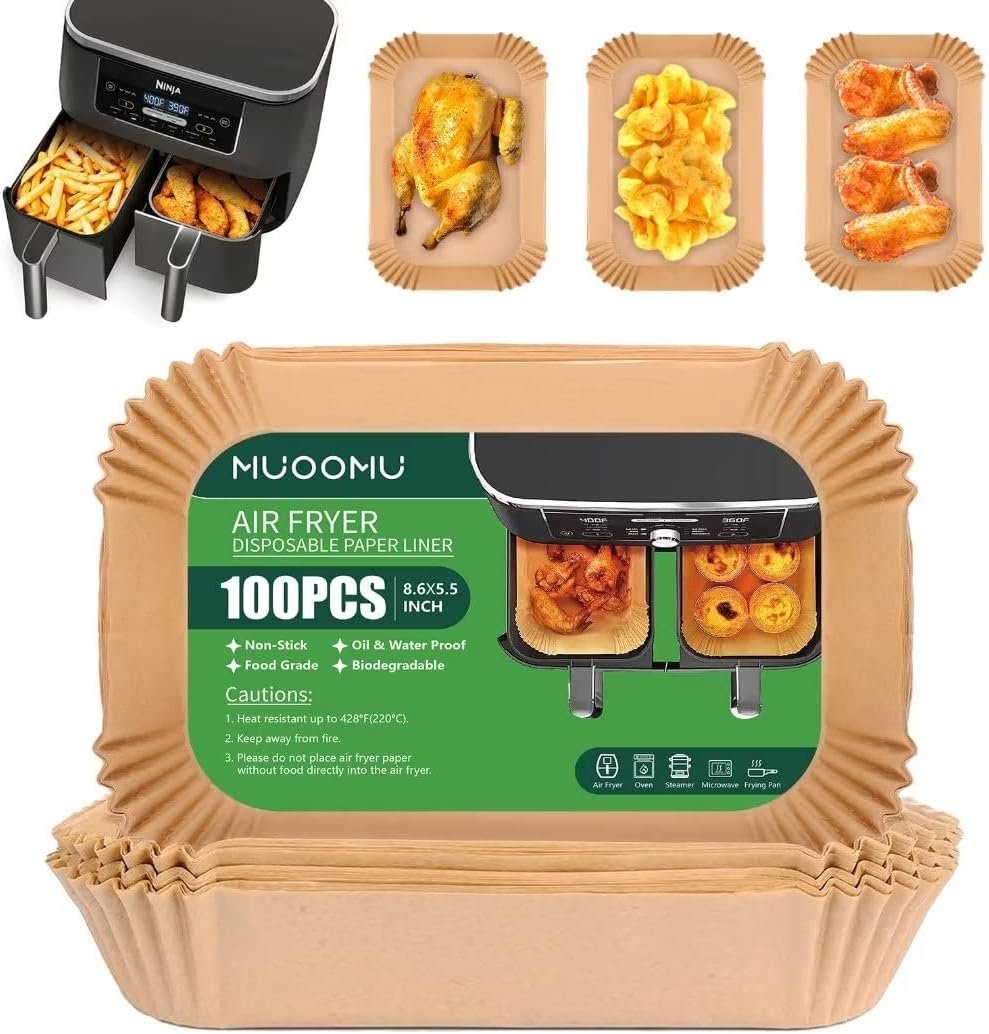
    Air Fryer Liner Information

    The product title also references air fryer liners.

    Liners are accessories designed to create a barrier between food and the cooking basket.

    They can help reduce direct food residue on the basket, although they must be used appropriately.

    An air fryer guide that discusses liners can introduce beginners to the accessory category and explain some of the practical considerations surrounding their use.

    Users should remember that liners can affect airflow and must be suitable for the temperature and cooking configuration of their particular air fryer.

    Kitchen Gift and Accessory Concept

    The product is also positioned as a kitchen gift or gadget for air fryer users.

    A cooking guide can be a relatively simple accessory compared with purchasing another appliance.

    It can be relevant for:

    • New air fryer owners
    • Home cooks
    • Families
    • Students
    • Apartment dwellers
    • People learning basic cooking
    • People who enjoy kitchen accessories

    The usefulness of any cooking guide ultimately depends on whether the recipient uses an air fryer regularly.

    How It Can Be Used

    Learning Basic Air Fryer Temperatures

    One of the simplest ways to use a cheat sheet is as a temperature reference.

    Beginners may not know which foods generally require higher or lower heat.

    A guide can provide starting points for common ingredients.

    For example, different temperatures may be appropriate for:

    • Vegetables
    • Frozen foods
    • Chicken
    • Fish
    • Steak
    • Baked foods
    • Reheating

    The user can then observe how the food cooks and make adjustments in future batches.

    This approach is particularly useful when transitioning from conventional oven recipes.

    Estimating Cooking Times

    Cooking time is another common question.

    A user may know the desired temperature but still wonder how long the food should remain in the air fryer.

    A cheat sheet can provide an approximate time range.

    However, the listed time should not be treated as a guarantee.

    A small chicken tender and a large chicken breast may require different amounts of time even when cooked at the same temperature.

    Similarly, a lightly filled basket can cook differently from a crowded one.

    The guide provides a starting point, while the actual food determines when cooking is complete.

    Preparing Frozen Foods

    Frozen foods are among the easiest applications for an air fryer.

    A guide can help beginners become familiar with common frozen foods such as:

    • French fries
    • Tater tots
    • Chicken nuggets
    • Breaded fish
    • Hash browns
    • Frozen vegetables
    • Mozzarella sticks
    • Frozen appetizers

    Package instructions should also be considered.

    Manufacturers of frozen foods may provide specific air fryer directions, and these can sometimes differ from generic cooking charts.

    A guide is most useful as a general reference rather than a replacement for food-specific instructions.

    Cooking Chicken

    Chicken is an important category for air fryer users.

    A cooking guide can provide an estimated temperature and time for foods such as:

    • Chicken wings
    • Chicken thighs
    • Chicken breasts
    • Drumsticks
    • Chicken tenders
    • Breaded chicken

    The internal-temperature information is particularly important here.

    The outside of chicken can become browned before the inside has reached a safe temperature.

    A food thermometer should therefore be used when appropriate to verify internal temperature.

    The cheat sheet can provide the target reference, but the thermometer provides the actual measurement.

    Preparing Vegetables

    Vegetables are another area where an air fryer cooking guide can be useful.

    Common options include:

    • Broccoli
    • Cauliflower
    • Brussels sprouts
    • Zucchini
    • Bell peppers
    • Asparagus
    • Green beans
    • Carrots
    • Sweet potatoes

    The guide can help establish an approximate temperature and cooking duration.

    Preparation still matters.

    A large piece of carrot will cook differently from a thin slice, while a whole Brussels sprout will behave differently from a halved one.

    Cutting vegetables into relatively consistent sizes can help produce more even results.

    Cooking Potatoes

    Potatoes are among the most common air fryer foods.

    The guide can help users establish starting points for:

    • French fries
    • Potato wedges
    • Cubed potatoes
    • Sweet potato fries
    • Hash browns
    • Tater tots

    For fresh potatoes, preparation can influence the result.

    Thickness, moisture, oil, and seasoning all play a role.

    Frozen potato products can vary significantly between brands, so package instructions remain useful.

    Preparing Fish and Seafood

    Air fryers can be used for fish and seafood when the food and appliance are suitable.

    A cooking guide can provide starting points for fish fillets, shrimp, and other common seafood.

    Fish can cook relatively quickly, so users should pay attention toward the end of the suggested cooking range.

    Overcooking can affect texture.

    The viewing and checking process is particularly important when learning how a specific air fryer behaves.

    Cooking Steak and Beef

    Steak, burgers, meatballs, and certain other beef preparations can be suitable for air frying.

    A guide can provide general temperature and timing references.

    For steak, desired doneness also matters.

    A cooking chart cannot know whether someone wants rare, medium-rare, medium, or well-done steak.

    Internal temperature is therefore more useful than time alone when determining doneness.

    Preparing Pork

    Pork chops, tenderloin, sausage, and bacon are examples of foods that may be prepared in an air fryer.

    Different cuts require different cooking approaches.

    A cheat sheet can help users establish a starting point while internal-temperature guidance can provide additional information for appropriate foods.

    Reheating Leftovers

    An air fryer can also be useful for reheating.

    A guide may provide suggestions for foods such as:

    • Pizza
    • Chicken
    • Roasted vegetables
    • Breaded foods
    • Potato dishes
    • Pastries

    The objective when reheating is usually to warm the food without unnecessarily drying it out.

    Lower temperatures and shorter cooking times may be appropriate depending on the food.

    Users should monitor the food rather than automatically applying a full cooking time intended for raw ingredients.

    Exploring New Recipes

    A beginner-oriented booklet can also serve as a source of inspiration.

    People sometimes purchase an air fryer for one specific purpose and later discover that it can prepare many other foods.

    A cookbook-style guide can encourage experimentation with different ingredients.

    Possible recipe categories include breakfast, lunch, dinner, snacks, side dishes, and desserts.

    This can help make the air fryer a more regular part of meal planning.

    Who It May Be Suitable For

    Air Fryer Beginners

    Beginners are perhaps the most obvious audience.

    Someone who has never used an air fryer may be unfamiliar with temperature settings, cooking times, food placement, and the differences between air frying and conventional baking.

    A simple physical reference can provide a starting framework.

    It can also help reduce the number of basic searches required during everyday cooking.

    New Air Fryer Owners

    Receiving or purchasing an air fryer often leads to the same initial question: “What can I make with it?”

    A cooking guide can answer that question by presenting common foods and cooking concepts in an accessible format.

    This can help users move beyond a small set of familiar recipes.

    Busy Home Cooks

    Busy cooks may appreciate quick access to information.

    When preparing dinner, opening a cookbook or searching through multiple websites can be inconvenient.

    A visible cheat sheet can provide basic information immediately.

    Families

    Families may benefit from having a shared reference in the kitchen.

    Different family members can use the air fryer, and a visible guide can make basic cooking information easier to access.

    Parents can also use the guide as a starting point when teaching older children or teenagers basic air fryer cooking.

    Food safety should still be taught separately.

    Students and Apartment Residents

    Air fryers are common in smaller living spaces because they can handle many cooking tasks without requiring a full kitchen.

    Students or apartment residents who are learning to cook may find a beginner-oriented guide useful.

    A compact reference can also take up little storage space.

    People Who Enjoy Kitchen Accessories

    The product can also appeal to people who enjoy practical kitchen gadgets and accessories.

    Unlike an appliance, a cheat sheet does not require electricity or maintenance.

    Its usefulness comes from being readily available when cooking.

    Important Things to Consider

    Cooking Charts Are Estimates

    This is perhaps the most important limitation.

    An air fryer cooking chart cannot account for every variable.

    Cooking times can change based on:

    • Appliance wattage
    • Basket capacity
    • Food quantity
    • Ingredient thickness
    • Starting temperature
    • Moisture content
    • Food arrangement
    • Airflow
    • Desired level of browning

    Therefore, a listed time should be treated as a starting point.

    Different Air Fryers Behave Differently

    Two air fryers set to the same temperature can still produce different results.

    One model may circulate air more aggressively, while another may have a different heating-element configuration.

    Basket shape also influences airflow.

    Users should learn how their specific appliance behaves rather than assuming that every published chart will be exact.

    Follow the Air Fryer Manufacturer’s Instructions

    A general cooking guide should complement, not replace, the appliance’s official manual.

    The manufacturer’s instructions may specify:

    • Maximum food capacity
    • Appropriate cooking temperatures
    • Preheating requirements
    • Cleaning procedures
    • Suitable accessories
    • Basket placement
    • Safety clearances

    Those instructions should take priority for appliance-specific information.

    Internal Temperature Requires a Thermometer

    A chart can provide an internal-temperature target, but it cannot measure food.

    For meat and poultry, a food thermometer is often the appropriate tool for verifying internal temperature.

    This distinction is particularly important for beginners.

    Do not assume that a particular number of minutes guarantees safe cooking.

    Food Size Matters

    The size of the ingredient can change cooking time significantly.

    For example, chicken breasts can vary greatly in thickness.

    The same applies to steak, fish, vegetables, potatoes, and other foods.

    When using a chart, compare the actual food with the general type described.

    Avoid Overcrowding

    Air fryers rely on hot-air circulation.

    Packing too much food into the basket can restrict airflow and affect browning.

    Even a large air fryer may require multiple batches when preparing a large quantity of food.

    Preheating Depends on the Recipe

    Not every air fryer recipe requires the same preparation process.

    Some recipes may benefit from preheating, while others can begin in a cold cooking chamber.

    Follow the appliance’s instructions and recipe guidance rather than assuming that preheating is mandatory for every food.

    Be Careful With Air Fryer Liners

    The product references air fryer liners, but liners require careful handling.

    Lightweight paper should not be allowed to move freely inside a hot air fryer.

    An unsecured liner can potentially move toward a heating element.

    Users should follow the liner manufacturer’s temperature and placement instructions and ensure that the liner does not interfere with normal airflow.

    Consider the Environmental Tradeoff

    Disposable liners can simplify cleanup, but they also create single-use waste.

    Reusable silicone liners or washable accessories may be preferable for people who want to minimize disposable products.

    There is no single solution that is right for every kitchen.

    Keep the Guide Away From Heat and Moisture

    Because the booklet or magnetic chart is intended to remain in the kitchen, its location matters.

    Steam, grease, splashes, and direct heat can damage printed materials.

    Place the guide somewhere convenient but sufficiently removed from the active cooking area.

    Comparison of General Air Fryer Cooking Reference Categories

    Different types of cooking resources serve different purposes.

    Magnetic Cheat Sheets

    Magnetic cheat sheets are designed for quick access.

    They can remain visible on a refrigerator or other suitable magnetic surface.

    Their strength is convenience.

    They are especially useful for frequently repeated questions such as cooking times and temperatures.

    Air Fryer Cookbooks

    Cookbooks generally provide more detailed information.

    A cookbook may include full recipes, ingredient lists, preparation instructions, variations, and serving suggestions.

    The tradeoff is that finding one specific temperature or time can take longer than checking a cheat sheet.

    A booklet that combines quick references with recipe-style information can sit somewhere between these two categories.

    Online Recipes

    Websites provide a huge amount of cooking information.

    They can be searched by ingredient, dietary preference, cooking method, or air fryer model.

    The main limitation is that online information can vary in quality, and users may need to compare multiple recipes.

    A physical guide offers a more consistent reference for basic cooking information.

    Mobile Apps

    Cooking apps can provide recipes, timers, shopping lists, and other interactive features.

    They are useful for people who prefer digital tools.

    However, they require access to a smartphone or tablet.

    A physical kitchen guide remains available without a device.

    Food Thermometers

    A thermometer is not a replacement for a cooking guide.

    The two tools perform different functions.

    A cooking guide provides an approximate time and temperature.

    A thermometer measures actual internal temperature.

    For meat and poultry, using both appropriately can provide a more complete cooking reference system.

    Recipe Cards

    Recipe cards are convenient for individual meals.

    They can contain detailed instructions for one dish but generally do not provide the same broad range of information as a cheat sheet.

    A general air fryer guide can therefore complement individual recipe cards.

    Practical Tips for Using an Air Fryer Cooking Guide

    Start With the Lower End of a Time Range

    If a guide provides a range, begin checking the food toward the earlier part of that range.

    This can help prevent smaller or thinner foods from becoming overcooked.

    Adjust for Food Quantity

    If the basket is heavily loaded, expect cooking behavior to change.

    Rather than assuming that twice as much food simply requires twice as much time, consider whether the food needs more space or multiple batches.

    Adjust for Thickness

    Thicker ingredients usually need more time than thin ones.

    When using a guide, consider the actual dimensions of the food.

    Keep Notes for Your Specific Air Fryer

    One useful way to learn an appliance is to record what works.

    For example, after preparing a particular batch of vegetables, a user can note the temperature, cooking time, quantity, and preferred texture.

    Over time, these notes can become a personalized extension of the general cheat sheet.

    Shake Small Foods When Appropriate

    Fries, vegetables, and other small ingredients may benefit from shaking during cooking.

    This redistributes the food and can expose different surfaces to circulating air.

    Turn Larger Foods When Necessary

    Even when an air fryer recipe does not specifically require turning, larger pieces may benefit from being repositioned.

    The need depends on the food and appliance design.

    Check Meat With a Thermometer

    When preparing meat or poultry, use the internal-temperature information as a reference and verify the actual temperature using a suitable food thermometer.

    Clean the Air Fryer Regularly

    A cooking guide can help with meal preparation, but it does not replace appliance maintenance.

    Regular cleaning can help remove grease, crumbs, and food residue.

    Follow the manufacturer’s instructions for cleaning the basket and interior.

    Frequently Asked Questions

    What is an air fryer cheat sheet?

    An air fryer cheat sheet is a quick-reference cooking guide that provides approximate temperatures, cooking times, and other useful information for common foods prepared in an air fryer.

    What is included in the Cathy Yoder-style air fryer cheat sheet booklet?

    The product is marketed as an air fryer cheat sheet and cookbook-style guide, with magnetic reference information and references to air fryer liners and kitchen accessories.

    The exact contents and recipe selection should be confirmed through the current product listing.

    Is this product an air fryer?

    No.

    It is a cooking reference and accessory product rather than an air fryer appliance.

    Is the guide suitable for beginners?

    Yes. The product is specifically presented as an air fryer cookbook and guide for beginners.

    It can provide a starting point for learning common temperatures, cooking times, and food ideas.

    Does the guide provide exact cooking times?

    Cooking guides provide approximate times rather than guarantees.

    Actual cooking time can vary based on the air fryer, quantity, food size, thickness, starting temperature, and other factors.

    Can I use the guide with any air fryer?

    The information is intended as general air fryer guidance.

    However, different appliances behave differently, so users should also follow the instructions supplied with their particular air fryer.

    Does the guide include recipes?

    The product is described as an air fryer cookbook and cooking guide.

    The exact recipes and number of recipes should be verified against the current product listing.

    What types of food can an air fryer guide help with?

    A general guide can provide starting points for foods such as potatoes, vegetables, chicken, meat, fish, frozen foods, snacks, breakfast items, and reheated foods.

    Does the guide include internal food temperatures?

    The product is marketed around air fryer cooking information, but users should verify the exact internal-temperature content in the current edition or product listing.

    For safe cooking of meat and poultry, reliable food-safety guidance should be used alongside the guide.

    Do I need a food thermometer?

    For meat, poultry, and other foods where internal temperature is important, a food thermometer is useful.

    A chart can provide a target temperature, but only a thermometer can measure the actual internal temperature.

    Can the magnetic guide be placed on a refrigerator?

    If the refrigerator surface is magnetic and suitable for the product, it may be used there.

    The guide should be kept away from excessive moisture, heat, and grease.

    Can I put the magnetic guide on an air fryer?

    Only if the specific surface is suitable and the placement does not expose the guide to excessive heat.

    A paper or magnetic guide should not be positioned where it can contact hot surfaces or interfere with appliance ventilation.

    What are air fryer liners?

    Air fryer liners are cooking accessories designed to create a barrier between food and the air fryer basket.

    They can help with cleanup and food release, but they need to be compatible with the appliance and used according to their instructions.

    Do air fryer liners affect airflow?

    They can.

    A solid liner can cover some of the ventilation holes in a basket, potentially changing airflow.

    Users should follow the liner manufacturer’s instructions and avoid obstructing important air passages.

    Can I preheat an air fryer with a paper liner inside?

    A loose paper liner should not be allowed to move freely during preheating.

    Airflow can lift lightweight parchment or paper toward a heating element.

    Follow the specific liner and air fryer manufacturer’s instructions before using a liner during preheating.

    Does a cooking chart replace the air fryer manual?

    No.

    The air fryer manual should remain the primary source for appliance-specific safety and operating instructions.

    Why do different air fryer recipes have different cooking times?

    Recipes may be written for different appliances, quantities, temperatures, and food sizes.

    Different airflow and heating systems can also produce different results.

    Can I use conventional oven recipes with an air fryer?

    Some oven recipes can be adapted for air frying, but the temperature and cooking time may need to be adjusted.

    A cooking guide can provide a starting reference.

    Should I always use the highest temperature?

    No.

    Higher temperatures are not automatically better.

    Different foods require different cooking conditions, and some foods can dry out or brown too quickly at excessive temperatures.

    Does an air fryer always need to be preheated?

    Not necessarily.

    Whether preheating is appropriate depends on the appliance and recipe.

    Follow the manufacturer’s instructions and the cooking guidance for the particular food.

    Can I cook multiple foods at once?

    That depends on the size and design of the air fryer.

    If there is sufficient room for airflow, multiple foods may be prepared together.

    However, foods with significantly different cooking requirements may be easier to prepare separately.

    Is an air fryer cheat sheet useful for meal prep?

    Yes.

    Knowing approximate cooking times for different ingredients can help organize meal preparation and determine which foods should be cooked first.

    Is this type of guide a good kitchen gift?

    It can be a practical gift for someone who regularly uses an air fryer, particularly a beginner who wants basic cooking references and recipe ideas.

    Conclusion

    The Air Fryer Cheat Sheet Magnets Booklet is designed around a straightforward idea: make common air fryer cooking information easier to access while preparing meals.

    For beginners, learning an air fryer can involve several small decisions. Temperature, cooking time, food preparation, basket arrangement, and internal temperature can all affect the final result. A physical cooking guide can provide a starting point without requiring the user to search online every time a common ingredient is prepared.

    The magnetic format adds convenience by allowing the reference to remain in the kitchen on a suitable magnetic surface. The booklet-style approach also gives the product a broader role than a single cooking chart, particularly because it is presented as an air fryer cookbook and beginner cooking guide.

    Its potential usefulness extends across many common foods, including potatoes, vegetables, chicken, meat, fish, frozen foods, snacks, breakfast items, and reheated leftovers. The references to air fryer liners and accessories also make it relevant to the wider group of tools commonly used alongside air fryers.

    However, a cooking chart should never be treated as an exact instruction for every appliance.

    Air fryers differ in power, airflow, heating configuration, basket design, and capacity. Ingredients also vary in size, thickness, moisture, quantity, and starting temperature. These factors can cause the same food to cook differently from one kitchen to another.

    For that reason, the most practical approach is to use the guide as a starting reference, then observe the food and adjust the settings when necessary. For meat and poultry, internal temperature is particularly important, and a suitable food thermometer provides information that a printed chart cannot.

    Air fryer liners also require appropriate handling. Disposable paper should remain within its intended temperature range, should not be allowed to move freely toward a heating element, and should not unnecessarily interfere with airflow.

    Compared with online recipes, a magnetic cheat sheet offers immediate physical access. Compared with a full cookbook, it can provide faster reference information. Compared with a food thermometer, it serves a different purpose by offering cooking guidance rather than measuring food.

    For someone learning to use an air fryer or simply looking for a convenient kitchen reference, a cheat sheet booklet can be a useful companion to the appliance itself.

    The most effective way to use it is alongside the manufacturer’s instructions, reliable food-safety guidance, and practical observation of how a particular air fryer cooks.
    You can check more details on Amazon here.

  • Cathy Yoder’s Air Fryer Cheat Sheet Set: A Practical Cooking Reference Guide

    Cathy Yoder’s Air Fryer Cheat Sheet Set: A Practical Cooking Reference Guide

    Air fryers are often simple to operate, but deciding how long to cook a particular food and what temperature to use can take some trial and error. A cooking chart can be especially useful when preparing an ingredient for the first time, adapting a conventional oven recipe, or trying to remember the recommended internal temperature for meat and poultry.

    Cathy Yoder’s Air Fryer Cheat Sheet Set is designed as a countertop cooking reference for these situations. Rather than functioning as a cooking appliance itself, the set provides quick-reference information intended to help air fryer users estimate cooking times, temperatures, and internal food temperatures for a wide range of commonly prepared foods.

    The product is marketed as a magnetic air fryer cheat sheet and cook-times chart, with information covering more than 80 popular foods. The reference material includes cooking temperatures, approximate cooking times, and internal food-temperature information. The magnetic format is designed to allow the charts to be placed on a refrigerator, metal appliance, or another suitable magnetic surface where they can remain visible during meal preparation.

    This type of accessory addresses a simple problem: air fryer recipes are not always consistent from one appliance to another. Basket size, heating power, airflow, food quantity, starting temperature, and ingredient thickness can all affect how quickly food cooks. A reference chart can provide a starting point, but it should not replace checking the food itself.

    Internal temperature information is particularly important for meat, poultry, and other foods where visual appearance alone may not reliably indicate doneness. A chart can tell the cook what temperature to aim for, while a properly used food thermometer provides a way to verify the temperature in the actual food.

    The Cathy Yoder Air Fryer Cheat Sheet Set can therefore be viewed as a convenience and reference accessory rather than a substitute for recipes, food-safety guidance, or the instructions supplied with an individual air fryer.

    This guide explains what the cheat sheet set offers, how it can be used in everyday cooking, who may find this type of accessory useful, and what limitations should be considered when relying on cooking charts.

    Key Features

    Magnetic Cooking Reference

    One of the defining characteristics of the set is its magnetic format.

    Instead of keeping a paper cooking chart inside a drawer or searching through a cookbook each time an ingredient needs to be prepared, a magnetic reference can be placed somewhere visible and accessible.

    Suitable locations may include:

    • A refrigerator door
    • A magnetic side panel of an appliance
    • A magnetic kitchen board
    • Another clean, dry magnetic surface

    The advantage is primarily convenience.

    The chart can remain available while preparing food, which can make it easier to check a temperature or approximate cooking time without stopping to search through another source.

    A magnetic reference is also relatively easy to move. If the kitchen arrangement changes, the chart can be repositioned.

    Information for More Than 80 Foods

    The product is described as covering more than 80 popular foods.

    A broad selection is useful because air fryers are commonly used for much more than frozen fries.

    A comprehensive reference can include different categories of foods such as:

    • Vegetables
    • Potatoes
    • Chicken
    • Beef
    • Pork
    • Seafood
    • Frozen foods
    • Breakfast foods
    • Snacks
    • Other everyday ingredients

    The exact foods and entries should be confirmed against the current product packaging or listing.

    The broader the selection of ingredients covered by a chart, the more frequently it may be useful in a kitchen.

    However, a chart covering many foods should still be treated as a general reference. Individual ingredients can differ significantly in size, thickness, moisture, preparation, and starting temperature.

    Cooking Time Reference

    Cooking time is one of the most useful pieces of information for an air fryer beginner.

    Someone preparing chicken wings, vegetables, salmon, or frozen snacks for the first time may have no idea where to start.

    A cheat sheet provides an approximate time range that can serve as an initial reference.

    For example, a chart might indicate that a particular food generally requires a certain number of minutes at a specified temperature.

    The user can then monitor the food and make adjustments based on actual cooking progress.

    This is important because cooking charts are not precise timers for every appliance.

    A particular air fryer may cook somewhat differently from another model. Basket size, fan strength, heating elements, and food placement all matter.

    Temperature Reference

    Cooking temperature is another central part of an air fryer recipe.

    Air fryers can operate across a relatively wide range of temperatures, but different foods require different approaches.

    A temperature reference can help users distinguish between lower-temperature cooking, moderate roasting, and higher-temperature crisping.

    The chart may be particularly useful for beginners who are not yet familiar with the temperature settings on their appliance.

    Instead of guessing whether a food should be prepared at 325°F, 375°F, or 400°F, the user can consult a reference and then adjust as necessary.

    Internal Food Temperature Information

    The inclusion of internal food temperatures is particularly important.

    For meat and poultry, the outside appearance of food does not always provide enough information to determine whether it has been cooked safely.

    An internal temperature chart provides a reference for target temperatures.

    However, there is an important distinction between a temperature recommendation and a temperature measurement.

    The cheat sheet can tell the cook what internal temperature to look for, but a food thermometer is required to measure the actual internal temperature.

    This makes the internal-temperature portion of the chart most useful when paired with an appropriate kitchen thermometer.

    Quick-Reference Format

    A cheat sheet is designed to be consulted quickly rather than read from beginning to end.

    This is useful when cooking because users often need one specific piece of information.

    For example:

    “What temperature should I start with?”

    “Approximately how long should this food cook?”

    “What internal temperature should chicken reach?”

    A well-organized reference chart puts those answers in a format that can be checked quickly.

    This can be particularly helpful during busy meal preparation.

    Designed for Air Fryer Cooking

    Air fryer cooking differs from conventional oven cooking.

    Hot air circulates around the food, and the relatively compact cooking chamber can heat food differently from a large oven.

    A dedicated air fryer reference chart is therefore designed around the types of cooking decisions air fryer users commonly face.

    It can provide a starting point for foods that are frequently prepared using circulating hot air.

    Still, users should not assume that an air fryer chart automatically applies to every model.

    Kitchen-Friendly Accessory

    Unlike a physical cooking appliance, the cheat sheet requires virtually no setup.

    It does not need electricity, charging, batteries, or a cooking cycle.

    Its main purpose is to remain accessible while the air fryer is being used.

    This makes it a relatively simple accessory for a kitchen that already has an air fryer.

    How It Can Be Used

    Starting a New Air Fryer Recipe

    One of the most straightforward uses is as a starting reference when preparing a food for the first time.

    Suppose someone wants to cook fresh broccoli but has never prepared it in an air fryer.

    Instead of guessing at both temperature and cooking time, the user can consult the chart for an approximate starting point.

    The food can then be monitored during cooking and adjusted if necessary.

    This approach is generally more practical than treating the listed time as an absolute guarantee.

    Cooking Frozen Foods

    Air fryers are frequently used for frozen foods.

    Examples include:

    • French fries
    • Tater tots
    • Chicken nuggets
    • Breaded fish
    • Frozen vegetables
    • Mozzarella sticks
    • Hash browns
    • Other frozen snacks

    A cooking chart can provide an initial temperature and time range.

    However, package instructions should also be considered.

    Different frozen products can have very different sizes and compositions, even when they belong to the same general category.

    A thin frozen potato product may cook differently from a thick-cut version.

    Preparing Chicken

    Chicken is an area where cooking time and internal temperature are both useful.

    A chart can provide an approximate air fryer temperature and cooking duration, while the internal temperature information can help determine when the chicken is adequately cooked.

    This is particularly relevant for:

    • Chicken breasts
    • Chicken thighs
    • Chicken wings
    • Drumsticks
    • Chicken tenders
    • Breaded chicken

    Thickness can make a major difference.

    Two chicken breasts of different sizes may require different cooking times even if they are cooked at the same temperature.

    For this reason, the chart’s internal-temperature information should be used alongside an actual thermometer.

    Cooking Beef

    Air fryers can also be used for certain beef preparations.

    Examples include:

    • Steak
    • Burgers
    • Meatballs
    • Small beef portions

    Internal temperature can be especially important when preparing beef because the desired level of doneness varies.

    A reference chart can provide target temperatures, but the user should determine the actual internal temperature with a thermometer when appropriate.

    Preparing Pork

    Pork can also be prepared in an air fryer.

    Depending on the cut, users may prepare:

    • Pork chops
    • Pork tenderloin
    • Small pork portions
    • Bacon
    • Sausage

    Cooking times can vary substantially between these foods.

    A reference chart can help users establish a starting point while the internal-temperature guidance provides an additional safety reference.

    Cooking Fish and Seafood

    Fish can cook relatively quickly in an air fryer.

    Salmon, white fish fillets, shrimp, and other seafood can be prepared using suitable settings.

    A cooking chart can help users estimate the initial cooking duration.

    Because seafood can dry out when overcooked, checking food earlier than the maximum suggested time can be useful.

    Preparing Vegetables

    Vegetables are another common air fryer category.

    The cheat sheet can serve as a quick reference for vegetables such as:

    • Broccoli
    • Cauliflower
    • Brussels sprouts
    • Zucchini
    • Carrots
    • Asparagus
    • Bell peppers
    • Green beans
    • Sweet potatoes

    Preparation affects cooking time.

    A whole carrot will cook differently from thin carrot sticks, and large broccoli florets behave differently from finely chopped pieces.

    The chart therefore works best as a starting point.

    Cooking Potatoes

    Potatoes are among the foods most frequently associated with air frying.

    Users may prepare:

    • French fries
    • Potato wedges
    • Cubed potatoes
    • Sweet potato fries
    • Hash browns
    • Tater tots

    Cooking time can vary depending on whether the potatoes are fresh or frozen and how thickly they are cut.

    The chart can help establish an initial temperature and duration.

    For fresh potatoes, a small amount of oil may also be used depending on the recipe.

    Preparing Breakfast Foods

    An air fryer can be useful for breakfast foods such as bacon, sausage, hash browns, and other suitable items.

    A quick-reference chart can be convenient during morning meal preparation because users may not want to search through a full recipe collection before starting a simple food.

    Different breakfast foods can also have very different cooking requirements, making a reference chart useful for quick comparisons.

    Reheating Food

    Some air fryer users primarily use their appliance for reheating leftovers.

    A reference guide can provide starting points for foods such as pizza, chicken, roasted vegetables, and other leftovers.

    Reheating generally requires less time than cooking raw food, so users should pay attention to the food rather than relying solely on a chart designed for full cooking.

    Planning Multiple Foods

    A chart can also be useful when planning a meal involving several foods.

    For example, someone preparing chicken and vegetables may consult the chart to estimate how long each component needs.

    This information can help determine which food should begin first.

    The chart does not need to provide an exact synchronized schedule. It simply gives the cook useful reference points for planning.

    Who It May Be Suitable For

    New Air Fryer Users

    Beginners may find a cheat sheet particularly useful.

    When someone first purchases an air fryer, even simple questions can arise:

    • What temperature should I use?
    • How long should this cook?
    • Should I check it halfway through?
    • What internal temperature should meat reach?

    A reference chart can provide a starting framework.

    This can make the learning process less dependent on guessing.

    Busy Home Cooks

    People who cook regularly may appreciate having commonly used information immediately available.

    Instead of repeatedly searching online for basic cooking times, a magnetic chart can remain in the kitchen.

    The convenience becomes especially relevant when preparing familiar foods that do not require a full recipe.

    Families

    In a family kitchen, different people may use the air fryer.

    A visible cooking reference can make basic information accessible to multiple household members.

    This can be useful when teenagers or other family members are learning to prepare simple meals.

    However, basic food-safety practices should still be explained rather than assuming a chart alone is sufficient.

    People Learning Air Fryer Cooking

    Someone transitioning from conventional oven cooking to air frying may need to learn new cooking times and temperatures.

    An air fryer-specific chart can serve as a bridge between the two methods.

    It can provide a starting point while users learn how their particular appliance behaves.

    People Who Frequently Cook Without Recipes

    Some home cooks prepare simple meals without following a complete recipe.

    For them, a quick-reference chart can provide useful guidance without requiring a detailed recipe for every ingredient.

    The chart can answer basic temperature and timing questions while leaving room for the cook to season and prepare food according to personal preferences.

    Meal-Prep Users

    People preparing several portions at once can use cooking-time information to plan their workflow.

    For example, a user might prepare chicken in one batch and vegetables in another.

    Knowing approximate cooking durations can help organize the process.

    The actual cooking time should still be adjusted according to quantity and food arrangement.

    Important Things to Consider

    A Cooking Chart Is a Starting Point

    One of the most important things to understand about any air fryer cheat sheet is that the listed times are estimates.

    Air fryers differ in:

    • Wattage
    • Basket size
    • Fan design
    • Heating elements
    • Cooking chamber geometry
    • Airflow
    • Food capacity

    Even two air fryers with the same stated capacity can produce different cooking results.

    The chart should therefore be treated as a starting reference rather than a guarantee.

    Food Size Changes Cooking Time

    Ingredient size can have a major impact.

    For example, a thin chicken tender and a thick chicken breast should not be expected to require identical cooking times.

    The same principle applies to:

    • Potato pieces
    • Fish fillets
    • Vegetables
    • Burgers
    • Meatballs
    • Frozen snacks

    Whenever possible, consider both the chart and the physical characteristics of the food.

    Starting Temperature Matters

    Food taken directly from a refrigerator can cook differently from food that has been sitting at room temperature.

    Frozen food can behave differently from refrigerated food.

    This is another reason why cooking charts should not be treated as exact timers.

    Don’t Rely on Color Alone

    Color and texture can provide useful clues, but they are not always enough to determine whether meat or poultry has reached a safe internal temperature.

    For foods where internal temperature matters, use a food thermometer.

    The chart can provide the target reference; the thermometer provides the measurement.

    Internal Temperatures Should Be Used Correctly

    When measuring meat or poultry, the thermometer should be inserted into the appropriate part of the food rather than simply touching the surface.

    For thicker foods, checking the center is generally more informative than checking only the exterior.

    Users should follow reliable food-safety guidance for thermometer placement and safe temperatures.

    Avoid Treating the Chart as a Recipe Book

    A cheat sheet is primarily a reference tool.

    It may tell you that a certain ingredient can be cooked at a particular temperature for an approximate amount of time, but it may not provide the complete recipe.

    Seasoning, preparation, marinades, oil quantity, cutting technique, and serving instructions may still need to come from another source.

    Check Your Air Fryer’s Manual

    The manufacturer’s instructions for the air fryer should remain an important reference.

    The manual can contain information about:

    • Maximum capacity
    • Suitable cookware
    • Temperature limits
    • Cleaning
    • Safety
    • Basket positioning
    • Preheating
    • Recommended cooking methods

    A third-party chart should not override the appliance manufacturer’s safety instructions.

    Consider the Physical Placement

    Because the chart is magnetic, it needs an appropriate surface.

    Not every refrigerator door or appliance side is magnetic.

    Before relying on a permanent placement, make sure the surface is suitable and the chart remains dry and readable.

    Keep the Chart Clean

    Kitchen environments can involve steam, oil, sauces, and food splashes.

    A visible reference chart can become dirty if it is positioned too close to active cooking.

    Keeping it in an accessible but protected location can help preserve readability.

    Comparison of General Air Fryer Reference Categories

    Air fryer cooking information is available in several formats, and each has a different role.

    Magnetic Cheat Sheets

    Magnetic charts are designed for quick access.

    They can remain visible in the kitchen and can be checked without opening a cookbook or searching on a phone.

    The Cathy Yoder set fits into this category.

    Its main purpose is convenience and quick reference.

    Printed Cookbooks

    Cookbooks generally provide more detailed information.

    A cookbook may include:

    • Full recipes
    • Ingredient quantities
    • Preparation instructions
    • Cooking methods
    • Serving suggestions
    • Variations

    The tradeoff is that finding one specific temperature or cooking time can take longer than looking at a compact cheat sheet.

    A cookbook and cheat sheet can therefore complement each other.

    Recipe Cards

    Recipe cards are useful for specific meals.

    They can provide detailed instructions for one recipe but generally cover fewer foods than a broad cooking chart.

    A cheat sheet is more useful for general reference across many ingredients.

    Mobile Apps

    Air fryer apps and recipe websites can provide extensive information and may include photographs, step-by-step instructions, user adjustments, and search functions.

    Their main limitation is dependence on a phone, tablet, or internet connection in some cases.

    A physical magnetic chart can provide basic information without requiring a screen.

    Digital Notes

    Some users simply keep cooking times in a phone note.

    This is flexible and customizable, but it requires opening the device and navigating to the information.

    A physical reference can be faster for simple, repeated questions.

    Food Thermometers

    A food thermometer serves a different purpose.

    It does not tell the cook how long a food should be cooked before starting. Instead, it measures the food’s actual internal temperature.

    For meat and poultry, a thermometer is an important complement to a cooking chart.

    The two tools serve different roles:

    Cheat sheet: provides an estimated cooking time and temperature.

    Thermometer: measures actual internal temperature.

    Using both can provide more useful information than relying on either one alone.

    Practical Ways to Use the Cheat Sheet

    Use It Before Starting

    Check the approximate temperature and cooking time before placing food into the air fryer.

    This gives you a starting plan.

    Check the Food Before the Listed Time Ends

    If the chart provides a range, begin checking toward the earlier part of that range.

    This is particularly useful with smaller pieces of food.

    Adjust for Quantity

    If you double the amount of food, do not automatically assume that the cooking time should simply be doubled.

    Air circulation and basket space affect cooking.

    A crowded basket can require a different approach.

    Adjust for Thickness

    Thicker foods generally need more time than thinner pieces.

    If your ingredient is significantly larger than the type described by the chart, use the listed information as a reference rather than a strict instruction.

    Shake or Turn When Appropriate

    Some foods benefit from redistribution.

    French fries, vegetables, and small frozen foods may cook more evenly when shaken.

    Larger pieces may benefit from being turned.

    Use the Internal Temperature Reference

    When cooking meat, poultry, or other foods where internal temperature matters, consult the target temperature information and verify the actual temperature with a thermometer.

    Keep Your Most-Used Information Accessible

    If certain foods are prepared regularly, placing the chart somewhere easy to see can save time.

    A refrigerator door or another suitable magnetic surface can make the information available while planning meals.

    Frequently Asked Questions

    What is Cathy Yoder’s Air Fryer Cheat Sheet Set?

    It is a cooking reference accessory designed for air fryer users. The set provides information about cooking temperatures, approximate cooking times, and internal food temperatures for more than 80 popular foods.

    Is the cheat sheet a recipe book?

    No. It is primarily a quick-reference cooking chart.

    It provides basic information such as temperatures and approximate times rather than serving as a complete collection of detailed recipes.

    How many foods are included?

    The product is described as covering more than 80 popular foods.

    The exact food list should be checked against the current product packaging or Amazon listing.

    What information does the chart provide?

    The product is designed to provide air fryer cooking times, temperature guidance, and internal food-temperature references.

    Is the chart magnetic?

    Yes. The product is designed as a magnetic air fryer cooking reference.

    It can be placed on a suitable magnetic surface in the kitchen.

    Where can I put the magnetic chart?

    Potential locations include a refrigerator door, magnetic appliance surface, or another suitable magnetic area.

    The surface should remain dry and accessible.

    Does the chart work with any air fryer?

    The chart is intended as a general air fryer cooking reference rather than a model-specific guide.

    Because air fryers vary, the listed cooking times should be treated as starting points.

    Always consider the instructions supplied with your particular air fryer.

    Are the cooking times exact?

    No.

    Cooking times should be considered approximate because ingredients, quantities, appliance design, airflow, food thickness, and starting temperature can all affect the result.

    Can beginners use this chart?

    Yes. A quick-reference chart can be particularly useful for people learning basic air fryer cooking.

    It can provide a starting temperature and approximate cooking time without requiring users to search for a recipe every time.

    Does the chart include internal food temperatures?

    Yes. Internal food-temperature information is one of the features described for the product.

    This information is particularly relevant when cooking meat and poultry.

    Do I still need a food thermometer?

    For foods where internal temperature is important, a food thermometer remains useful.

    The chart provides a target or reference, while the thermometer measures the actual temperature inside the food.

    Can I use the chart for frozen food?

    Yes, the chart is intended to cover a wide range of popular foods, including common air fryer applications.

    However, frozen foods can vary considerably by brand, size, and preparation, so package instructions should also be considered.

    Can the chart be used for vegetables?

    Yes. Vegetable cooking is a common air fryer application, and a broad air fryer cooking reference can provide starting points for different vegetables.

    Can it help with chicken?

    Yes. A cooking chart can provide approximate temperature and timing information for chicken, while internal-temperature guidance can help with safe cooking.

    Can it be used for steak?

    It can provide general cooking guidance for steak.

    Because steak thickness and desired doneness vary, actual internal temperature should be checked when appropriate.

    Can it be used for fish?

    Yes. Fish and seafood are common air fryer foods.

    Because fish can cook relatively quickly, monitoring the food during the latter part of the recommended range is useful.

    Does the cheat sheet replace the air fryer’s instruction manual?

    No.

    The air fryer manufacturer’s manual should remain the primary source for appliance-specific safety, operation, capacity, and maintenance instructions.

    Does it replace recipes?

    No.

    A cheat sheet provides quick-reference information, while recipes provide detailed preparation instructions.

    Can I use it without an internet connection?

    Yes. Because it is a physical reference, the information is available without needing an internet connection.

    Is a magnetic cheat sheet better than using a phone?

    It depends on personal preference.

    A phone provides access to a much larger amount of information, while a physical chart can be faster for repeatedly checking basic cooking times and temperatures.

    Can the chart be used by the whole family?

    Yes. A visible kitchen reference can make basic air fryer information accessible to different household members.

    Food-safety guidance should still be explained to anyone who is learning to cook.

    Is this useful for meal preparation?

    It can be.

    Knowing approximate cooking times for different foods can help users plan the order in which ingredients should be prepared.

    Can I use the chart for every type of food?

    The chart is designed to cover many common foods, but it will not necessarily contain every ingredient or recipe.

    For foods not listed, users can consult other reliable cooking resources and their air fryer’s instructions.

    Why can the same food have different cooking times in different air fryers?

    Air fryers differ in wattage, basket shape, airflow, heating elements, and cooking-chamber design.

    Food quantity and preparation also affect cooking time.

    This is why chart times should be treated as estimates.

    What should I do if my food is not cooked after the suggested time?

    Continue cooking as appropriate while monitoring the food.

    For meat and poultry, check internal temperature using a suitable food thermometer.

    If food consistently requires significantly different cooking times, record the settings that work for your particular air fryer.

    Conclusion

    Cathy Yoder’s Air Fryer Cheat Sheet Set is designed as a simple reference accessory for people who want commonly used air fryer cooking information available in the kitchen.

    Its magnetic format allows the chart to remain visible on a suitable magnetic surface, while the stated coverage of more than 80 popular foods gives it a broad range of potential applications. Rather than focusing on detailed recipes, the cheat sheet is centered on practical information such as approximate cooking times, temperature guidance, and internal food-temperature references.

    That makes it particularly relevant for everyday questions.

    A new air fryer user may want to know where to start when cooking vegetables, potatoes, chicken, fish, frozen foods, or other common ingredients. Someone who already uses an air fryer regularly may simply want a convenient reminder without searching through a cookbook or phone.

    The internal-temperature information is especially useful when preparing meat and poultry, but it should be understood correctly. A chart can provide a target temperature, while a food thermometer is used to determine the actual internal temperature of the food.

    The same principle applies to cooking times.

    An air fryer chart cannot account perfectly for every appliance, food quantity, ingredient thickness, starting temperature, basket arrangement, or recipe. Different air fryers can produce different cooking results, even when the same temperature and time are selected. The chart is therefore most useful as a starting reference rather than a guarantee.

    Compared with a cookbook, the magnetic cheat sheet emphasizes speed and convenience. Compared with a mobile recipe app, it provides physical information that does not require a screen or internet connection. Compared with a food thermometer, it serves a different purpose by providing cooking estimates rather than measuring the food itself.

    For people who regularly prepare meals with an air fryer and want frequently used temperature and timing information within easy reach, a physical cooking reference can be a practical addition to the kitchen.

    Used alongside the air fryer’s manufacturer instructions, reliable food-safety guidance, and a food thermometer when appropriate, the cheat sheet can help make everyday air fryer cooking more organized and predictable.

    You can check more details on Amazon here.

  • 13QT Vertical Dual Basket Air Fryer With Dual-Zone Sync Finish: A Practical Guide

    13QT Vertical Dual Basket Air Fryer With Dual-Zone Sync Finish: A Practical Guide

    Air fryers have become increasingly flexible kitchen appliances, particularly as manufacturers have moved beyond traditional single-basket designs. Instead of preparing one type of food at a time, dual-basket models allow users to cook different foods simultaneously, while larger-capacity designs provide additional room for family meals and meal preparation.

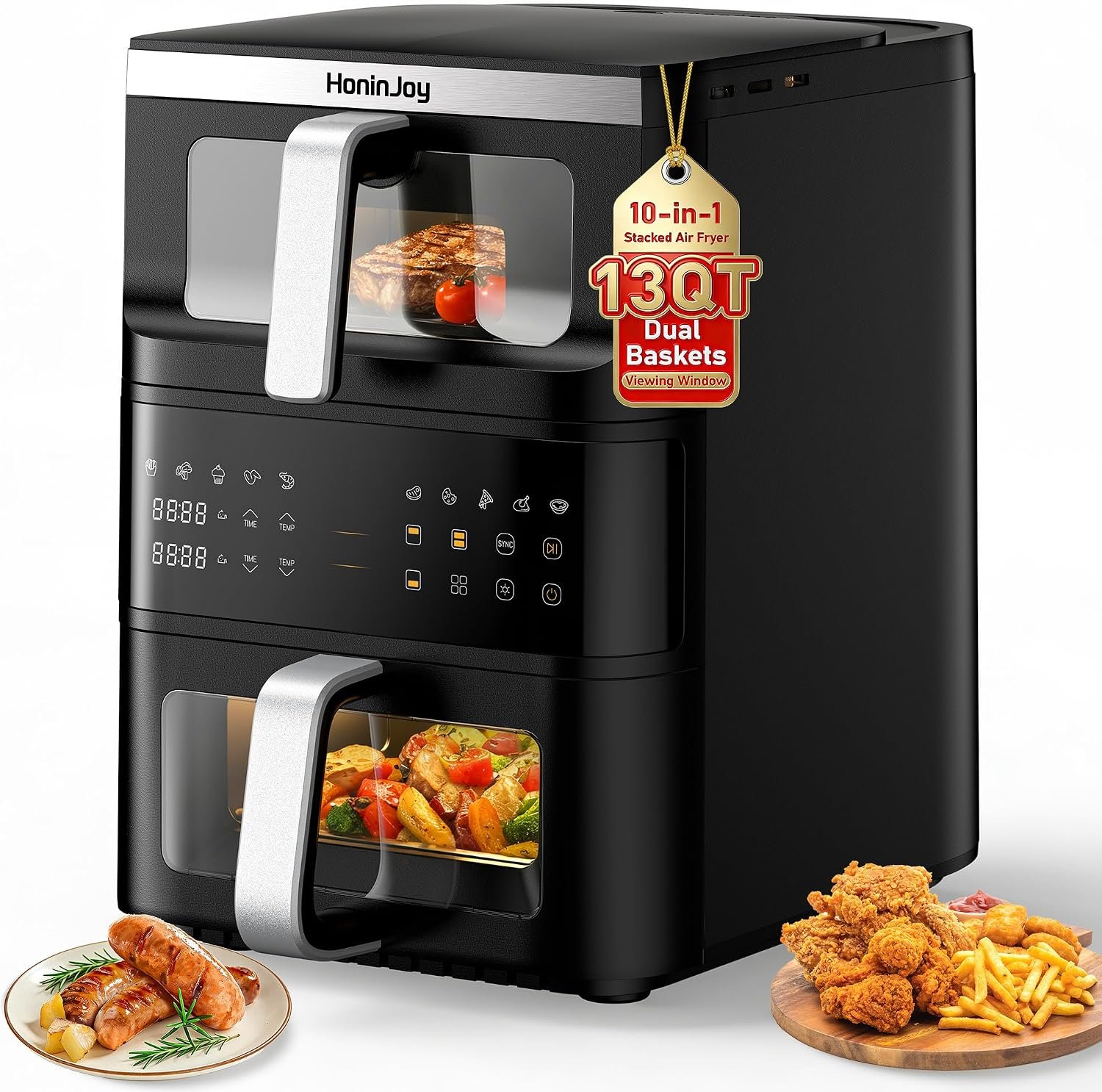
    The 13QT Vertical Dual Basket Air Fryer is designed around this concept. It combines a large stated capacity with a vertical configuration, two independent cooking zones, and a Sync Finish function intended to coordinate the completion time of foods that may require different cooking settings.

    The product is associated with the Honinjoy brand and is described as a compact vertical dual-basket air fryer with viewing windows. Its vertical design places the two cooking compartments one above the other rather than side by side. This approach can be useful in kitchens where horizontal countertop space is limited.

    Dual-zone cooking also introduces another practical advantage: users can prepare different foods using separate baskets. One basket might contain vegetables while the other contains chicken, potatoes, or another component of the meal. Because the cooking zones are independent, different temperatures and cooking times can be selected when appropriate.

    The Sync Finish feature is designed to coordinate the two cooking zones so that foods with different preparation times can finish at approximately the same time. This can make meal planning more straightforward, especially when one food requires considerably more cooking time than another.

    At the same time, a large dual-basket air fryer requires some understanding of capacity, airflow, countertop space, electrical requirements, and cooking technique. A 13-quart rating does not mean every type of food should be packed into the baskets, and independent zones work best when each basket has sufficient room for hot air to circulate.

    This guide explains the main characteristics of the 13QT Vertical Dual Basket Air Fryer, how the dual-zone system can be used, what types of households may find this format useful, and what should be considered before adding a large vertical air fryer to a kitchen.

    Key Features

    13-Quart Overall Capacity

    The 13-quart capacity is one of the defining characteristics of this air fryer.

    A large total capacity can be useful for households that regularly prepare multiple portions or prefer to cook several components of a meal at once.

    Capacity becomes especially interesting in a dual-basket appliance because the total cooking space is divided between two separate compartments. Instead of placing all food into one large basket, users can distribute different ingredients between the two cooking zones.

    This can be useful for meals such as chicken with vegetables, fish with potatoes, or a protein paired with a side dish.

    The actual amount of food that can be cooked effectively depends on the ingredients and how much space they require for airflow. Foods such as fries, vegetables, and breaded pieces generally benefit from being arranged with sufficient space around them.

    For this reason, capacity should be considered alongside basket dimensions and cooking habits rather than as a standalone measurement.

    Vertical Dual-Basket Design

    The vertical arrangement is one of the more distinctive aspects of the appliance.

    Many dual-basket air fryers place two baskets next to each other. A vertical model instead stacks the cooking zones.

    This can help conserve horizontal countertop space.

    For kitchens with limited counter width, the vertical format may provide a way to access two cooking compartments without requiring a wide appliance footprint.

    There is a tradeoff, however. A taller appliance may require more vertical clearance, particularly underneath cabinets or shelves.

    Before placing a vertical air fryer in a permanent location, it is useful to measure not only the countertop area but also the space above it.

    Two Independent Cooking Zones

    The two baskets allow users to prepare different foods separately.

    This is one of the primary reasons people choose a dual-basket air fryer rather than a single-basket model.

    For example, one basket can contain chicken while the other contains vegetables. The two foods may require different temperatures or cooking times, so independent controls allow them to be managed separately.

    This arrangement can also be useful when one person prefers a different seasoning or preparation method from another.

    Because the food remains physically separated, flavors and moisture are less likely to mix between the two cooking zones.

    Dual-Zone Sync Finish

    Sync Finish is designed to address a common challenge with dual-zone cooking.

    Different foods rarely require exactly the same cooking time.

    For example, chicken may require considerably longer than frozen vegetables, while a larger portion of potatoes may take longer than a small serving of fish.

    Without a synchronization function, the user might need to start one basket later than the other manually.

    A Sync Finish feature allows the cooking schedules to be coordinated so that both zones are intended to finish at approximately the same time.

    This can make meal timing easier.

    It is important to understand that Sync Finish coordinates the programmed cooking cycles. It does not make two foods cook at identical rates or guarantee that every ingredient will reach the desired condition simultaneously.

    Food size, quantity, starting temperature, and arrangement can all influence the actual cooking process.

    Separate Temperature and Time Control

    Independent cooking zones generally provide the ability to configure the two baskets according to their respective foods.

    This is useful because different ingredients often require different cooking temperatures.

    For example:

    • Chicken may require one temperature and longer cooking time.
    • Vegetables may require a different temperature.
    • Frozen foods may have their own recommended settings.
    • Fish may cook relatively quickly at a moderate temperature.
    • Reheating leftovers can require gentler heat.

    The ability to separate the cooking zones provides greater flexibility than placing all ingredients into a single basket.

    Viewing Windows

    The appliance is designed with viewing windows that allow users to observe food during cooking.

    A viewing window can be useful for monitoring browning, checking the progress of delicate foods, or deciding whether additional cooking time is necessary.

    Being able to see the food without opening the basket can also reduce the need to interrupt the cooking environment simply to check appearance.

    Visual monitoring is particularly useful when learning how a particular recipe behaves in a new air fryer.

    Cooking times are not always identical between appliances, even when the temperature setting is the same. The viewing window provides another way to judge progress alongside the timer.

    Vertical Space Efficiency

    The vertical structure is more than an aesthetic choice.

    Two horizontally positioned baskets can create a relatively wide appliance footprint. Stacking the baskets vertically can reduce the amount of counter width required.

    This can be useful for:

    • Apartment kitchens
    • Smaller countertops
    • Kitchenettes
    • RV or compact cooking spaces
    • Kitchens with limited horizontal room

    The tradeoff is height.

    Users should make sure there is enough space above the air fryer for ventilation and for opening or accessing the upper cooking compartment.

    Multifunction Cooking

    A dual-basket air fryer can be used for a wide range of foods.

    Common applications include:

    • Air frying
    • Roasting
    • Reheating
    • Cooking frozen foods
    • Preparing vegetables
    • Cooking poultry
    • Preparing fish
    • Heating snacks
    • Cooking side dishes

    The exact available cooking programs and controls should be confirmed against the product’s supplied instructions.

    The important concept is that the two cooking zones can be used independently, allowing different foods to be prepared at the same time.

    How It Can Be Used

    Preparing a Complete Dinner

    One of the most practical applications of a dual-basket air fryer is preparing two parts of a meal simultaneously.

    For example, one basket can hold seasoned chicken while the second contains potatoes.

    The cooking settings can be adjusted independently.

    If the chicken needs more time than the potatoes, the Sync Finish function can be used to coordinate their programmed completion times.

    This can reduce the need to prepare side dishes separately.

    The result is not necessarily a faster meal in every situation, but it can make the cooking workflow more organized.

    Cooking Protein and Vegetables Separately

    Chicken, fish, beef, tofu, and vegetables can all be prepared in separate baskets.

    Keeping the foods separated is useful when they require different temperatures or when users want to avoid mixing flavors.

    For example, a strongly seasoned protein can cook in one basket while lightly seasoned vegetables cook in the other.

    The independent zones also make it easier to adjust one food without disturbing the other.

    Preparing Different Frozen Foods

    Frozen foods can be convenient candidates for dual-zone cooking.

    One basket could contain frozen fries while the other contains breaded chicken or vegetables.

    Because different frozen foods often have different recommended cooking times, the independent baskets can help manage them separately.

    Users should still follow the package instructions and adjust the time when necessary.

    Frozen foods can vary significantly in thickness and composition, so a preset should be treated as a starting point rather than a universal rule.

    Cooking Breakfast Foods

    A dual-basket air fryer can also be useful for breakfast.

    Possible combinations include:

    • Bacon and hash browns
    • Sausage and potatoes
    • Breakfast vegetables and sausage
    • Toasted foods and breakfast proteins
    • Reheated pastries and other baked items

    The separate compartments make it possible to prepare foods that might otherwise need separate pans.

    However, foods with high fat content should be monitored carefully, and grease should be handled according to the appliance’s cleaning and safety instructions.

    Reheating Different Leftovers

    A dual-basket system can also be useful when reheating several foods that require different approaches.

    For example, one basket may contain pizza while another contains roasted vegetables.

    The foods remain separate, and each zone can be adjusted independently.

    Reheating at a moderate temperature can help warm leftovers without unnecessarily drying them.

    The appropriate time depends on the food and its starting temperature.

    Preparing Snacks for Multiple People

    For households with children or several family members, two cooking compartments can make snack preparation more flexible.

    One basket can contain one type of food while the second handles another.

    Examples include:

    • Chicken nuggets
    • Potato bites
    • Mozzarella sticks
    • Vegetable snacks
    • Spring rolls
    • Frozen appetizers

    The separation between the baskets can also be useful when different foods require different cooking times.

    Cooking Meal-Prep Portions

    Meal preparation can be another practical application.

    Users can prepare a protein in one zone and a vegetable or carbohydrate component in the other.

    For example:

    Zone 1: Seasoned chicken pieces

    Zone 2: Roasted vegetables

    The finished foods can then be divided into meal-prep containers.

    The 13-quart overall capacity can provide useful space, although the practical number of portions will depend heavily on the food and how much space it needs for proper airflow.

    Roasting Vegetables

    Vegetables such as broccoli, cauliflower, carrots, Brussels sprouts, zucchini, and peppers can be prepared in an air fryer.

    A small amount of oil and seasoning can be added before cooking.

    The vegetables should be distributed rather than compressed into a dense pile.

    Different vegetables can also be prepared in the two baskets when their cooking requirements differ.

    Cooking Chicken Wings

    Chicken wings are a common air-fryer application.

    The dual-basket format can be useful when preparing wings alongside another food.

    The wings can be seasoned independently, while the second basket handles potatoes or vegetables.

    Because chicken wings contain fat and can release grease, regular cleaning remains important.

    As with all poultry, the final cooking condition should be confirmed using an appropriate internal temperature rather than relying exclusively on surface appearance.

    Preparing Fish

    Fish fillets can be cooked separately from vegetables or other side dishes.

    The viewing window can be particularly useful for delicate foods because it allows users to observe the cooking process without constantly opening the compartment.

    Fish can become dry if overcooked, so monitoring cooking progress is helpful.

    Reheating Pizza

    Pizza can be reheated in an air fryer to warm the toppings and restore some surface texture.

    The dual-basket system could allow pizza to be reheated while another food is prepared in the second compartment.

    The actual size of pizza that fits depends on the dimensions of the individual basket.

    Who It May Be Suitable For

    Families

    The 13-quart overall capacity may be useful for families that regularly prepare several portions.

    Two baskets allow the household to separate proteins and side dishes while cooking them simultaneously.

    This can be especially useful for dinners where different ingredients require different temperatures.

    Couples and Smaller Households

    Although the capacity is relatively large, smaller households can still benefit from the independent cooking zones.

    One basket can be used for a meal while the other remains available for another food.

    However, people who usually cook very small portions may find that a compact single-basket air fryer takes up less space.

    The larger capacity is most useful when it matches actual cooking habits.

    People With Limited Counter Width

    The vertical format may appeal to people whose primary kitchen limitation is horizontal countertop space.

    Stacking the cooking zones can provide two baskets without requiring the same width as a side-by-side dual-basket design.

    This can be particularly relevant in small apartments or compact kitchens.

    Meal-Prep Users

    People who regularly prepare several components of meals may find independent baskets convenient.

    A protein can be prepared in one zone while vegetables or another side dish are prepared in the second.

    The Sync Finish function can also simplify timing when the two foods have different cooking durations.

    People Cooking Different Foods at Once

    Dual-basket air fryers are particularly useful for households where several foods need to be prepared simultaneously.

    Instead of waiting for one food to finish before starting another, the two cooking zones can operate independently.

    People Who Want to Reduce Cooking Complexity

    The ability to cook two foods at once can simplify the sequence of preparing a meal.

    Instead of coordinating a stovetop pan, oven tray, and separate appliance, users may be able to prepare several components in the dual-basket air fryer.

    It does not replace every other cooking method, but it can consolidate some countertop cooking tasks.

    Important Things to Consider

    Measure the Appliance Before Buying

    Vertical air fryers solve one space problem while potentially creating another.

    They may use less horizontal space than side-by-side dual-basket models but require more vertical clearance.

    Measure:

    • Counter width
    • Counter depth
    • Total appliance height
    • Space underneath cabinets
    • Clearance around ventilation areas

    Do not assume that a tall appliance will fit comfortably beneath existing kitchen cabinets.

    Understand the 13-Quart Capacity

    The 13-quart rating represents overall capacity rather than a guarantee of usable food volume in every situation.

    Each basket has its own physical limits.

    Foods that require substantial airflow may need to be spread across the basket rather than piled high.

    A large capacity is most useful when the food can be arranged appropriately.

    Sync Finish Does Not Synchronize Cooking Conditions

    Sync Finish is a scheduling function.

    It coordinates the completion times of the two programmed cooking cycles.

    It does not make different foods cook at the same rate.

    If one food requires 25 minutes and another requires 15 minutes, the system can coordinate their start times so that both programs are scheduled to finish together.

    However, actual cooking results can still vary.

    Some Foods May Still Need Shaking or Turning

    A dual-zone air fryer may reduce manual intervention, but it does not eliminate it for every food.

    Small foods such as fries, vegetables, and frozen snacks may benefit from being shaken.

    Larger foods may benefit from being turned.

    The need depends on the food and the desired result.

    Avoid Overcrowding

    One of the most common air-fryer mistakes is treating the basket like a conventional oven tray and filling it as much as possible.

    Air needs room to circulate.

    If food is stacked too tightly, the cooking process can change.

    For foods where crispness is important, leaving sufficient space can be especially important.

    Consider the Electrical Load

    Large air fryers can consume substantial electrical power.

    Users should follow the appliance’s electrical specifications and use an appropriate outlet.

    Avoid assuming that a multi-outlet extension or power strip is suitable for a high-wattage kitchen appliance.

    If multiple high-power appliances are operating on the same household circuit, the electrical load should also be considered.

    Keep the Appliance Away From Restricted Areas

    Air fryers release heat and require appropriate ventilation.

    A vertical model should not be pushed directly underneath a cabinet or against a wall if doing so conflicts with the manufacturer’s recommended clearance.

    The space around the appliance should allow heat to dissipate safely.

    Cleaning Two Baskets

    A dual-basket system provides additional flexibility but also creates more components to clean.

    Food residue can accumulate in both baskets, racks, or trays depending on the configuration.

    Cleaning after cooking can help prevent grease buildup.

    If the components are dishwasher safe, users should verify exactly which parts can go into the dishwasher and whether the manufacturer specifies a particular rack or cleaning method.

    Ceramic or Nonstick Surfaces Require Care

    If the cooking baskets use a nonstick coating, users should avoid unnecessary scratching.

    Metal utensils or abrasive cleaning tools may damage some coated surfaces.

    Follow the manufacturer’s instructions regarding utensils, cleaning products, and dishwasher use.

    Food Safety Remains Essential

    An air fryer does not automatically guarantee safe cooking.

    Raw poultry, meat, and seafood should reach appropriate internal temperatures.

    A food thermometer can be especially useful for thicker foods.

    The exterior of a piece of chicken may look fully browned before the interior has reached a safe temperature.

    Cooking Different Foods Together

    Dual baskets make it possible to cook different foods simultaneously, but not every combination is equally practical.

    Foods with dramatically different cooking temperatures or preparation requirements may need more careful planning.

    The Sync Finish function can help with timing, but users still need to select suitable settings for each food.

    Comparison of General Air Fryer Categories

    Choosing an air fryer often comes down to cooking habits, available space, and the type of meals being prepared.

    Compact Single-Basket Air Fryers

    Compact models generally have a smaller footprint and lower capacity.

    They can work well for individuals or smaller portions.

    Their main limitation is that preparing a full meal may require multiple cooking cycles.

    A 13-quart dual-basket design provides considerably more separation and cooking space, but it also requires more physical room.

    Standard Large Single-Basket Air Fryers

    Large single-basket models provide one cooking chamber.

    They can be useful when a household usually prepares a large quantity of the same food.

    The advantage of a dual-basket model is separation.

    Instead of putting all foods into the same compartment, users can cook different ingredients independently.

    Side-by-Side Dual-Basket Air Fryers

    Side-by-side models provide two cooking zones next to each other.

    They are convenient for users who want both baskets at the same height and easy visibility.

    The tradeoff is horizontal countertop width.

    A vertical dual-basket air fryer takes the opposite approach by stacking the compartments.

    Vertical Dual-Basket Air Fryers

    Vertical models emphasize countertop width efficiency.

    They can provide two independent cooking zones while occupying less horizontal space than some side-by-side designs.

    The main consideration is height.

    Users need to ensure adequate vertical clearance and easy access to the upper basket.

    Air Fryer Toaster Ovens

    Air fryer toaster ovens generally use a larger rectangular cooking chamber and racks or trays.

    They can accommodate foods that need more vertical or horizontal room and may be useful for toast, baking, and larger dishes.

    A vertical dual-basket air fryer focuses more specifically on separate basket-style cooking zones.

    Multifunction Countertop Cookers

    Some multifunction appliances combine air frying with pressure cooking, steaming, slow cooking, and other methods.

    These can be useful for people who want multiple cooking technologies in one appliance.

    A dual-basket air fryer instead focuses on independent hot-air cooking zones.

    The choice depends on whether the household values separate simultaneous cooking or a wider variety of cooking technologies.

    Practical Tips for Using a Dual-Basket Air Fryer

    Plan the Meal Before Starting

    Think about the cooking time and temperature required for each component.

    For example:

    • Chicken: longer cooking time
    • Vegetables: moderate cooking time
    • Frozen fries: shorter cooking time
    • Fish: often shorter cooking time

    Sync Finish can then be used to coordinate the schedules.

    Start With the Food That Needs More Time

    When manually coordinating two baskets, the food with the longer cooking time generally needs to begin first.

    A synchronization feature can simplify this process by coordinating the start times automatically.

    Use Separate Seasonings

    One benefit of two baskets is that different foods can be seasoned independently.

    This is useful when one family member prefers mild seasoning while another prefers stronger flavors.

    It also prevents ingredients from sharing sauces or spices unnecessarily.

    Leave Space Around Food

    Do not treat a large-capacity basket as a deep storage container.

    Spread food across the cooking area whenever practical.

    Air circulation remains one of the most important factors in air-fryer cooking.

    Shake When Appropriate

    Even if the two-zone system makes cooking more convenient, small foods may still benefit from being shaken.

    A quick shake can redistribute pieces and expose different surfaces to circulating air.

    Check Thick Foods With a Thermometer

    For meat and poultry, use an appropriate food thermometer when needed.

    This provides more useful information than judging doneness solely by exterior appearance.

    Clean After Greasy Foods

    Foods such as bacon, wings, sausages, and fatty meats can leave substantial residue.

    Cleaning the baskets and cooking surfaces after use can reduce accumulated grease and odors.

    Allow Adequate Cooling Before Cleaning

    Cooking components can remain hot after the cooking cycle ends.

    Allow the appliance and removable parts to cool sufficiently before washing them.

    Frequently Asked Questions

    What is the capacity of the vertical dual-basket air fryer?

    The appliance is marketed with a total capacity of 13 quarts.

    Because the cooking area is divided between two baskets, the available space is distributed between the two cooking zones.

    What is a vertical dual-basket air fryer?

    A vertical dual-basket air fryer places two separate cooking compartments one above the other rather than side by side.

    This design can reduce horizontal countertop requirements while still providing independent cooking zones.

    What is Sync Finish?

    Sync Finish is a feature designed to coordinate two cooking programs so that the food in both baskets is scheduled to finish at approximately the same time.

    It is particularly useful when the two foods require different cooking durations.

    Can I cook two different foods at the same time?

    Yes. The two independent cooking zones are designed to allow different foods to be prepared simultaneously.

    Each zone can be configured according to the food being cooked.

    Can the two baskets use different temperatures?

    The dual-zone design is intended for independent cooking, allowing different settings to be selected for the two foods when appropriate.

    Always follow the product instructions for the available temperature and time controls.

    Does Sync Finish make both foods cook at exactly the same rate?

    No.

    Sync Finish coordinates the timing of the cooking programs. Different foods can still cook differently based on their size, quantity, moisture, and starting temperature.

    Does food still need to be flipped?

    Some foods may still benefit from shaking or turning.

    The dual-zone design does not eliminate the normal cooking considerations associated with air circulation.

    Is a 13-quart air fryer suitable for a family?

    A 13-quart overall capacity can provide useful space for family meals, particularly when using both baskets.

    The actual number of servings depends on the food and how much room it needs for airflow.

    Can I cook chicken and vegetables together?

    Yes. One basket can be used for chicken while the other prepares vegetables.

    This is one of the practical applications of having independent cooking zones.

    Can I cook frozen foods in the air fryer?

    Yes. Frozen foods are commonly prepared in air fryers.

    Cooking time and temperature should be based on the specific food and its instructions.

    Can I reheat leftovers?

    A dual-basket air fryer can be used for suitable reheating applications.

    Different foods can be reheated separately if they require different settings.

    Can I prepare vegetables in one basket and meat in the other?

    Yes.

    Separating meat and vegetables can also help prevent flavors and juices from mixing between the two cooking areas.

    Does a vertical design save counter space?

    A vertical design can reduce horizontal countertop width compared with some side-by-side dual-basket models.

    However, it requires more vertical clearance.

    Should I measure my cabinets before using a vertical air fryer?

    Yes.

    Height is particularly important with vertical appliances.

    Check the appliance dimensions and the manufacturer’s recommended clearance before placing it under cabinets or shelving.

    Can I fill both baskets completely?

    It is generally better not to overcrowd either basket.

    Air circulation is important, and foods often cook more evenly when they are arranged with enough space around them.

    Is a dual-basket air fryer better than a single-basket model?

    The two categories serve different needs.

    A dual-basket appliance is useful for preparing two foods independently, while a single-basket model may be simpler for people who usually cook one food or one type of meal at a time.

    Is a vertical dual-basket model different from a side-by-side model?

    Yes.

    The primary difference is physical layout.

    A vertical model stacks the cooking zones, while a side-by-side model places them next to one another.

    Vertical models can reduce width but require more height.

    Can the air fryer replace a conventional oven?

    It can perform several tasks that are also possible in an oven, but it should not automatically be considered a complete replacement.

    A conventional oven generally provides substantially more interior space and may be better suited to large baking dishes or meals.

    Can I cook meat safely in an air fryer?

    Yes, suitable cuts of meat can be prepared in an air fryer.

    However, safe internal temperatures should be verified using reliable food-safety guidance and, when appropriate, a food thermometer.

    How should I clean a dual-basket air fryer?

    Allow the appliance to cool, remove the appropriate cooking components, and clean them according to the manufacturer’s instructions.

    Avoid immersing electrical components in water.

    Does the viewing window mean I never need to open the basket?

    Not necessarily.

    The window makes it easier to monitor food, but some foods may still need to be shaken, turned, or checked directly during cooking.

    Can I prepare a complete meal using both baskets?

    Yes.

    The dual-zone format is particularly suited to preparing a main protein in one basket and a side dish in the other.

    The Sync Finish feature can help coordinate their cooking schedules.

    Conclusion

    The 13QT Vertical Dual Basket Air Fryer represents a countertop cooking format designed around two priorities: independent cooking zones and efficient use of vertical space.

    Its 13-quart overall capacity provides substantial room for preparing multiple portions, while the two separate baskets allow different foods to be cooked at the same time. This can be useful for complete meals where the protein and side dishes require different temperatures or cooking durations.

    The vertical configuration is particularly relevant for kitchens where countertop width is limited. By placing the cooking compartments one above another, the appliance can provide dual-zone functionality without relying on the same horizontal footprint as many side-by-side models.

    Another important feature is Dual-Zone Sync Finish. This function addresses a common challenge with simultaneous cooking: two foods often require different amounts of time. Coordinating their programmed finish times can make it easier to have the components of a meal ready together.

    The viewing windows add another practical element by allowing users to monitor food during cooking. This can be useful when checking browning, especially when learning how a new recipe behaves in an unfamiliar appliance.

    At the same time, the large capacity should be used thoughtfully. A bigger basket does not mean food should always be packed tightly. Air circulation remains central to air-fryer cooking, and foods may need space around them to cook and brown effectively.

    Users should also consider the appliance’s vertical dimensions, countertop clearance, electrical requirements, cleaning routine, and the cooking requirements of individual foods. The Sync Finish feature coordinates cooking schedules, but it does not eliminate the need to select suitable temperatures, monitor food, or verify the safe internal temperature of meat and poultry.

    Compared with compact single-basket models, the 13QT vertical format places greater emphasis on simultaneous meal preparation. Compared with side-by-side dual-basket appliances, it prioritizes vertical space efficiency. And compared with air fryer toaster ovens, it focuses more specifically on separate basket-style cooking zones.

    For households that regularly prepare two different foods at once, the combination of a large total capacity, independent baskets, vertical construction, and synchronized cooking can provide a practical approach to everyday countertop cooking.

    As with any kitchen appliance, the most suitable choice depends on actual cooking habits, available space, desired capacity, and the types of foods prepared most frequently.

    You can check more details on Amazon here.

  • Air Fryer Disposable Paper Liners for Ninja Dual Air Fryers: A Practical Guide to Parchment Liners

    Air Fryer Disposable Paper Liners for Ninja Dual Air Fryers: A Practical Guide to Parchment Liners

    Air fryer accessories can make a noticeable difference in how convenient it is to prepare and clean up after everyday meals. While an air fryer can cook foods using circulating hot air, ingredients such as breaded chicken, seasoned vegetables, cheese-based foods, and marinades can leave behind grease, crumbs, or baked-on residue. Disposable paper liners are one accessory designed to address part of that cleanup challenge.

    The Air Fryer Disposable Paper Liners described in this guide are rectangular parchment-style liners measuring approximately 8.6 by 5.5 inches and are supplied in a 100-piece package. They are designed for use with compatible rectangular air fryer baskets, including certain Ninja dual-basket air fryer configurations. The product is described as non-stick, oil resistant, and water resistant, with applications extending to baking and other countertop cooking uses.

    Unlike reusable silicone inserts or traditional round parchment sheets, rectangular disposable liners are shaped around the dimensions of certain dual-basket air fryer compartments. This can make them particularly relevant for people who regularly use rectangular cooking baskets and want an accessory that can be placed directly inside the cooking area.

    At the same time, parchment liners need to be used correctly. They should not interfere with airflow, should not be placed in an empty preheating basket unless the manufacturer’s instructions specifically permit it, and must remain within the temperature limits specified for the particular liner. Disposable paper does not eliminate the need for normal air fryer safety practices.

    This guide explains what these liners are, how they can be used, which cooking situations they may suit, how they compare with other liner categories, and what to consider before adding disposable parchment liners to an air fryer routine.

    Key Features

    Rectangular 8.6 x 5.5-Inch Design

    The most important physical characteristic of these liners is their rectangular shape.

    The liners measure approximately 8.6 inches by 5.5 inches. This format is intended to correspond with the shape of certain rectangular air fryer baskets rather than the round baskets found in many traditional air fryers.

    Dimensions matter with air fryer liners because an improperly sized liner can fold over the edges, interfere with airflow, or fail to cover the intended cooking surface.

    A liner that is too large can potentially become exposed to a heating element or obstruct circulation. A liner that is too small may leave much of the cooking surface uncovered.

    For that reason, users should compare the dimensions of the liner with the actual interior dimensions of their air fryer basket rather than relying only on a general statement such as “fits dual air fryers.”

    The 8.6 x 5.5-inch dimensions make these liners particularly relevant for compatible rectangular baskets.

    100 Disposable Liners

    The package contains 100 individual paper liners.

    A large quantity can be useful for people who use parchment liners frequently because each cooking cycle can use a fresh liner when appropriate.

    Disposable accessories can also be convenient for occasional cooking. Instead of washing a reusable liner after every meal, users can remove the used paper and dispose of it according to local waste-handling practices.

    However, disposable does not automatically mean environmentally preferable.

    The tradeoff is straightforward: disposable liners can reduce washing and simplify cleanup, while reusable silicone or other washable accessories generate less single-use waste over repeated use.

    The best choice depends on cooking frequency, cleanup preferences, storage space, and personal priorities.

    Parchment-Style Material

    The liners are made from parchment-style paper intended for cooking applications.

    Parchment paper is commonly used as a barrier between food and a cooking surface. In an air fryer, this barrier can help reduce direct contact between certain foods and the basket.

    This can be useful when cooking ingredients that tend to stick or release substantial amounts of residue.

    The paper also creates a separation between food and the basket, which may make the basket easier to clean afterward.

    However, parchment paper is still paper. It should not be treated as a heat-proof metal or silicone component, and users need to follow the temperature limitations provided for the specific product.

    Non-Stick Surface

    The liners are described as non-stick.

    A non-stick surface can help reduce the amount of food that adheres directly to the liner during cooking.

    This can be particularly useful with foods such as marinated chicken, seasoned vegetables, small pastries, and other ingredients that may otherwise leave residue behind.

    It is important to distinguish between “non-stick” and “nothing can ever stick.”

    Food behavior depends on ingredients, moisture, cooking temperature, sauces, and cooking duration. Some foods may still adhere to parchment, particularly when cooked for a long period or when their composition causes caramelization.

    The liner should therefore be viewed as a cooking barrier that can help with food release and cleanup, rather than a guarantee that every food will slide off effortlessly.

    Oil Resistant

    The product is described as oil proof or oil resistant.

    This characteristic is relevant because many air-fryer foods contain oil, either naturally or because a small amount is added during preparation.

    A liner designed to resist oil can help prevent grease from quickly penetrating through the paper and reaching the basket underneath.

    This may be particularly useful when cooking foods such as:

    • Chicken wings
    • Sausages
    • Bacon
    • Marinated vegetables
    • Potato wedges
    • Breaded foods
    • Certain meat preparations

    Oil resistance does not mean the liner should be used to hold excessive amounts of liquid oil. Air fryer baskets are designed around hot-air circulation rather than deep-frying.

    Water Resistant

    The liners are also described as waterproof or water resistant.

    This can be useful when cooking foods with higher moisture content.

    A water-resistant cooking liner can help reduce the amount of liquid residue that reaches the cooking basket. This may make cleanup more manageable after preparing foods with marinades, sauces, or naturally high moisture.

    Nevertheless, users should not assume that a parchment liner turns an air fryer basket into a completely sealed container.

    Liquid should never be added in quantities that are incompatible with the air fryer’s design.

    Designed for Compatible Ninja Dual Air Fryers

    The product is marketed as an accessory for Ninja dual air fryers and rectangular air fryer baskets.

    This is an important distinction because air fryer baskets vary considerably in shape and dimensions.

    Even two appliances with similar stated capacities may have different basket geometries.

    Before using these liners, users should verify that the dimensions and shape match their particular air fryer.

    Compatibility should be determined by actual basket dimensions and manufacturer guidance rather than the product category alone.

    Suitable for Baking Applications

    The liners can also be used for certain baking applications where parchment-style paper is appropriate.

    Parchment can serve as a barrier between baked food and the cooking surface, potentially making food removal easier.

    Possible applications include small baked items, pastries, cookies, and other foods that can safely be prepared in an air fryer.

    However, the air fryer itself must be suitable for the intended baking task, and the liner must remain within its stated temperature limits.

    Disposable Cleanup Solution

    One of the primary practical purposes of an air fryer liner is reducing cleanup effort.

    After cooking, users can allow the liner and food to cool appropriately, remove the liner, and clean any remaining residue from the basket as necessary.

    This does not necessarily eliminate cleaning completely.

    Grease can sometimes escape around the liner’s edges, and the basket may still need washing.

    The liner is therefore better understood as a cleanup aid rather than a replacement for cleaning.

    How These Air Fryer Paper Liners Can Be Used

    Cooking Frozen Foods

    Frozen foods are among the simpler applications for parchment liners.

    Examples include:

    • French fries
    • Tater tots
    • Frozen chicken pieces
    • Hash browns
    • Breaded vegetables
    • Frozen appetizers

    A liner can help keep crumbs and seasoning from accumulating directly on the basket.

    However, food placement remains important.

    Air needs to circulate around the ingredients. If a liner covers too much of the basket or food is packed tightly on top of it, the cooking environment can change.

    A liner should fit the cooking surface without unnecessarily blocking airflow.

    Preparing Chicken Wings

    Chicken wings can release fat during cooking.

    A parchment liner can help collect some of the residue and reduce direct contact between the food and the basket.

    However, wings are also a food where airflow matters significantly.

    If the liner has holes or is designed in a way that allows airflow, follow the product instructions. If it is a solid parchment sheet, avoid assuming that it will provide identical airflow to an uncovered perforated basket.

    The quantity of wings also matters.

    Overcrowding can affect browning and cooking consistency regardless of whether a liner is being used.

    Cooking Vegetables

    Vegetables such as broccoli, cauliflower, zucchini, peppers, and potatoes can be cooked with parchment underneath.

    This can be particularly useful when vegetables have been coated with oil or seasoning.

    The liner can catch some of the residue and reduce the amount of food that becomes stuck directly to the basket.

    For vegetables that release moisture, however, users should avoid creating an excessively crowded layer. Air circulation remains part of the cooking process.

    Preparing Fish

    Fish can sometimes be delicate and difficult to remove cleanly from a cooking surface.

    A parchment liner may provide a smoother barrier between the fish and the basket.

    This can be useful for fillets that are prone to breaking during removal.

    Users should still handle fish carefully and use appropriate cooking temperatures.

    A liner does not change the basic requirements for safely preparing seafood.

    Cooking Marinated Foods

    Marinated foods can leave sticky residue behind as sauces and seasonings heat.

    Examples include:

    • Teriyaki chicken
    • Barbecue chicken
    • Marinated vegetables
    • Glazed meat
    • Seasoned tofu

    A parchment liner can help contain some of the residue.

    However, highly liquid sauces should not be allowed to pool excessively inside an air fryer.

    The appliance remains a hot-air cooking device, and excessive liquid may interfere with its operation or create unwanted splattering.

    Baking Small Foods

    Parchment liners can also be useful for small baking projects.

    Cookies, pastries, biscuits, and certain small cakes may benefit from a parchment barrier.

    The liner can help reduce sticking and make removal easier.

    Before baking, check that the paper lies flat and remains contained within the cooking surface.

    Loose paper can become a safety concern if it moves toward a heating element.

    Reheating Leftovers

    The liners can also be used when reheating foods that may leave crumbs or grease.

    Pizza, breaded chicken, roasted vegetables, and similar leftovers can be placed over the liner.

    The paper barrier may help reduce food residue on the basket.

    Because reheating typically requires less time than cooking raw foods, cleanup can also be relatively straightforward.

    Cooking Small Baked Snacks

    For foods such as small pastries, biscuits, or snack-size baked items, a parchment liner can provide a convenient cooking surface.

    The key is to avoid exceeding the liner’s intended temperature range.

    Users should also consider the shape and size of the food. The liner should remain securely inside the basket throughout cooking.

    Who These Liners May Be Suitable For

    Owners of Compatible Dual-Basket Air Fryers

    These liners may be especially useful for people who own compatible Ninja dual-basket air fryers with rectangular cooking compartments.

    The rectangular dimensions are more closely aligned with this type of basket than with conventional round air fryers.

    Users should still verify dimensions before use.

    People Who Cook Frequently

    Frequent air fryer users may appreciate having disposable liners available for routine meals.

    A fresh liner can simplify cleanup after foods that produce crumbs, grease, or sticky residue.

    For someone using an air fryer several times a week, that convenience may be meaningful.

    People Preparing Messy Foods

    Foods with marinades, sauces, cheese, breading, or seasoning can create more cleanup than simple dry ingredients.

    A parchment liner can provide a barrier that catches some of this residue.

    Examples include glazed chicken, breaded foods, roasted vegetables with oil, and certain baked snacks.

    People Who Prefer Disposable Accessories

    Some users simply prefer disposable cooking accessories because they can reduce washing.

    This is a convenience preference rather than a universal advantage.

    Reusable silicone liners or washable inserts can be more appropriate for users who want to minimize single-use waste.

    People Who Bake in an Air Fryer

    If an air fryer is regularly used for baking, parchment liners can provide another option for managing food release and cleanup.

    They can be useful for recipes where parchment is already commonly used in conventional baking.

    Important Things to Consider

    Check the Dimensions Before Use

    The most important compatibility factor is size.

    These liners measure approximately 8.6 by 5.5 inches.

    Measure the usable cooking surface of your air fryer basket before assuming that the liner fits.

    A liner should not protrude excessively over the edges.

    Never Use a Loose Liner During Empty Preheating

    One of the most important air fryer parchment-paper safety principles is that lightweight paper should not be allowed to move freely inside a hot cooking chamber.

    If the air fryer is turned on while an empty liner is inside, circulating air can potentially lift the paper.

    If the liner moves toward a heating element, it can create a fire hazard.

    A safer approach is to place food on the liner so that the food’s weight helps keep it in position, while also following the liner and air fryer manufacturer’s instructions.

    If the appliance manufacturer specifically provides different guidance, that guidance should take priority.

    Do Not Assume All Parchment Is Identical

    Different parchment products can have different maximum temperature ratings and intended applications.

    Even if another parchment liner has been used successfully at a particular temperature, that does not automatically mean every disposable liner has the same rating.

    Always check the packaging or manufacturer’s instructions for the specific liner being used.

    Airflow Still Matters

    Air fryers work through circulating hot air.

    A solid paper liner can change the way air moves through the cooking basket.

    If the liner blocks ventilation holes or covers areas designed to support airflow, the cooking behavior may differ from an uncovered basket.

    This is particularly important for recipes where crispness depends on strong circulation.

    Users should follow the specific liner’s intended-use instructions and avoid modifying the liner in ways not recommended by the manufacturer.

    Avoid Excessive Liquid

    Water-resistant paper does not mean the liner is intended to contain large amounts of liquid.

    Air fryers are not designed to operate like pots or saucepans.

    Liquid marinades should be controlled so that they do not pool excessively.

    For very wet foods, a liner may not be the appropriate accessory.

    Consider Food Weight

    Food placed on the liner can help keep it in place.

    Very lightweight foods may not provide enough weight to prevent movement, particularly when strong airflow is circulating.

    This is another reason to avoid starting an air fryer with a loose piece of parchment inside an empty basket.

    Do Not Allow Paper to Touch Heating Elements

    The liner should remain within the cooking area and away from exposed heating elements.

    This is especially important in air fryers where the heating element is positioned relatively close to the food.

    If a liner is too large or improperly positioned, part of it could rise or fold toward the heat source.

    Disposable Does Not Mean Unlimited Use

    A parchment liner is intended as a disposable cooking accessory.

    Reusing it can change its physical condition, especially after exposure to grease, moisture, high temperatures, and food residue.

    If a liner becomes torn, excessively greasy, brittle, or otherwise damaged, it should be discarded rather than reused.

    Cleaning Is Still Necessary

    A liner can reduce the amount of residue reaching the basket, but it cannot guarantee a completely clean basket after every cooking cycle.

    Grease can move around the edges, and crumbs may fall beneath the paper.

    The air fryer basket should still be cleaned as needed.

    Consider Environmental Impact

    Disposable liners offer convenience, but 100 individual sheets represent 100 potential pieces of single-use waste.

    For people who use an air fryer every day, reusable silicone inserts may be worth considering.

    For occasional users, disposable parchment may provide a convenient option without requiring storage and cleaning of another reusable accessory.

    The choice depends on personal priorities.

    Disposable Parchment Liners vs. Other Air Fryer Liner Categories

    There are several common ways to protect or line an air fryer cooking surface.

    Disposable Parchment Liners

    Disposable parchment liners are designed for convenience.

    Their main characteristics include:

    • Single-use design
    • Lightweight construction
    • Simple cleanup
    • Paper-based cooking barrier
    • No need to wash after use

    They can be particularly practical when preparing messy foods.

    Their main limitation is that they create recurring waste and require careful placement around the heating system.

    Reusable Silicone Liners

    Silicone air fryer liners are designed to be washed and reused.

    They can be useful for people who cook frequently and want to reduce the amount of disposable material used.

    Silicone also tends to be more substantial than parchment, which can make it easier to handle.

    However, reusable liners need to be cleaned after each use and may occupy more storage space.

    They can also change airflow depending on their design.

    Perforated Parchment Sheets

    Perforated parchment liners contain holes intended to allow more air to circulate through the cooking surface.

    They can be useful for foods where airflow is particularly important.

    Compared with solid sheets, perforated designs may provide a different balance between cleanup protection and air circulation.

    However, the exact hole pattern and dimensions still need to match the air fryer.

    Reusable Air Fryer Mats

    Reusable mats made from heat-resistant materials can provide a washable barrier between food and the basket.

    They are generally intended for repeated use and may be available in different shapes and sizes.

    The tradeoff is similar to silicone liners: less single-use waste, but more cleaning after cooking.

    Unlined Air Fryer Baskets

    Using the air fryer without a liner is the simplest approach.

    It allows the basket’s original airflow design to operate without an additional barrier.

    The downside is that food residue and grease come directly into contact with the basket, potentially increasing cleanup requirements.

    For foods that do not stick heavily or create substantial residue, using the original basket without a liner may be entirely practical.

    Practical Tips for Using Disposable Air Fryer Liners

    Match the Liner to the Basket

    Before cooking, place the liner inside the basket while the appliance is cool.

    Check that it sits within the cooking surface and does not fold over the sides.

    Add Food Before Starting the Cooking Cycle

    Avoid placing an empty lightweight liner inside a hot air fryer.

    Food should provide sufficient weight to hold the liner in place when appropriate.

    Always follow the specific manufacturer’s instructions.

    Keep Food Distributed Evenly

    Place food across the liner rather than creating an unnecessarily tall pile.

    This helps maintain airflow around the ingredients.

    Avoid Covering More Than Necessary

    A liner should not extend beyond the intended cooking area.

    If it is oversized, it may interfere with airflow or move during cooking.

    Monitor Cooking Times

    A parchment liner can slightly change how food contacts the cooking surface.

    This means that a recipe may behave somewhat differently from one prepared directly in the basket.

    Keep an eye on food during the first few attempts with a particular recipe.

    Let the Liner Cool Before Handling

    After cooking, the liner and food may remain extremely hot.

    Allow them to cool sufficiently before removing the paper.

    Do not grab a hot liner with bare hands.

    Dispose of Used Liners Properly

    Once the liner has cooled, remove it carefully and dispose of it according to local waste guidelines.

    If it contains significant amounts of grease or food residue, avoid placing it into recycling unless local recycling rules specifically permit that type of material.

    Frequently Asked Questions

    What size are these air fryer liners?

    The liners are approximately 8.6 inches by 5.5 inches.

    Their rectangular shape is intended for compatible rectangular air fryer baskets.

    How many liners come in the package?

    The package contains 100 disposable paper liners.

    Are these liners designed for Ninja dual air fryers?

    They are marketed as accessories for compatible Ninja dual air fryer configurations.

    However, compatibility should always be confirmed by comparing the liner dimensions with the actual basket dimensions of the specific appliance.

    Are the liners non-stick?

    Yes. The product is described as having a non-stick surface intended to help reduce food sticking.

    The level of food release can still vary depending on the ingredients and cooking conditions.

    Are the liners oil resistant?

    The product is described as oil proof or oil resistant.

    This makes the liners suitable for applications where food releases some grease or oil during cooking.

    Are the liners waterproof?

    They are described as waterproof or water resistant.

    However, this does not mean they should be used to contain large amounts of liquid inside an air fryer.

    Can these liners be used for baking?

    They can be used for certain baking applications where parchment-style paper is appropriate.

    The cooking temperature should remain within the liner’s specified limits.

    Can the liners be used in a microwave?

    The product description indicates microwave use among its intended applications.

    Users should still follow the packaging instructions and make sure the liner is appropriate for the specific microwave application.

    Can they be used in an oven?

    The product is described for oven-related cooking applications, but users should verify the maximum temperature and intended use on the specific packaging before placing a liner in an oven.

    Can the liners be reused?

    They are designed as disposable liners.

    Although a sheet may appear intact after one use, repeated exposure to heat, grease, and moisture can change the paper. Reusable silicone or other washable liners are better suited to repeated use.

    Do air fryer liners prevent food from becoming crispy?

    Not necessarily, but any liner can influence airflow and how food contacts the cooking surface.

    Solid parchment can reduce direct airflow through basket perforations compared with an uncovered basket.

    For foods where maximum air circulation is important, users should follow the liner manufacturer’s guidance and consider whether a perforated liner or no liner is more appropriate.

    Do these liners eliminate the need to clean the air fryer?

    No.

    They can reduce the amount of food and grease that reaches the cooking basket, but residue can still get underneath or around the edges.

    The basket should still be cleaned regularly.

    Can parchment liners catch fire in an air fryer?

    Parchment is combustible and must be used within its intended temperature range.

    The biggest concern is allowing lightweight parchment to move toward a heating element.

    Never use a loose liner in an empty preheating air fryer unless the appliance manufacturer specifically states that this is safe.

    Can I put a liner in the air fryer before preheating?

    Users should follow the instructions supplied with the specific liner and air fryer.

    As a general safety principle, lightweight parchment should not be allowed to sit unsecured in an empty basket while hot air is circulating.

    Do these liners fit every Ninja dual air fryer?

    No accessory should be assumed to fit every model simply because it is marketed for a product family.

    Basket dimensions and shapes can differ between models.

    Check the measurements of the cooking basket against the approximately 8.6 x 5.5-inch liner dimensions.

    Are disposable liners better than silicone liners?

    Neither category is universally better.

    Disposable parchment liners can be convenient because they require no washing, while silicone liners can be reused repeatedly.

    The choice depends on cleaning preferences, frequency of use, airflow requirements, storage, and waste considerations.

    Can these liners be used with greasy foods?

    Yes, the liners are described as oil resistant and can be used with suitable greasy foods.

    However, they should not be used to hold large quantities of free oil, and the air fryer should always be operated according to its intended cooking method.

    Can these liners be used for frozen foods?

    They can be used with suitable frozen foods, provided the liner remains within its temperature and usage specifications.

    Food should still be arranged so that hot air can circulate effectively.

    Can I use these liners with chicken wings?

    They can be used with chicken wings if the liner fits the basket and is used within its temperature limitations.

    Because wings benefit from airflow, avoid overcrowding the cooking surface.

    Can I use them with vegetables?

    Yes. Vegetables such as broccoli, cauliflower, zucchini, peppers, and potatoes can be prepared on a suitable parchment liner.

    Are these liners environmentally friendly?

    Disposable parchment liners are convenient but are still single-use products.

    People looking to minimize disposable waste may prefer a reusable silicone or washable air fryer liner.

    Conclusion

    Air fryer disposable paper liners can be a practical accessory for people who want to make cleanup easier after cooking.

    The 8.6 x 5.5-inch rectangular liners discussed here are designed around the dimensions of compatible rectangular air fryer baskets, particularly certain dual-basket configurations. The package contains 100 disposable sheets, giving frequent air fryer users a supply for repeated cooking sessions.

    Their parchment-style construction, non-stick surface, oil resistance, and water resistance make them suitable for a variety of everyday applications. They can be used beneath foods such as vegetables, chicken, fish, potatoes, frozen snacks, leftovers, and certain baked items when the liner and appliance are used according to their respective instructions.

    One of the main advantages of a disposable liner is convenience. Instead of having food residue directly on the cooking basket, a liner can provide a barrier that catches some crumbs, seasoning, grease, and moisture. Removing the used liner can make the cleanup process simpler, although it does not eliminate the need to wash the basket.

    Compatibility and safe placement are especially important.

    The approximately 8.6 x 5.5-inch dimensions should be compared with the actual cooking surface of the air fryer before use. A liner should remain contained within the basket and should not interfere with airflow or move toward the heating element.

    Users should also avoid placing loose parchment in an empty air fryer while it is preheating unless the appliance’s instructions specifically permit that use. Food placed on the liner can help hold it in position, but normal safety precautions still apply.

    Compared with reusable silicone liners, disposable parchment offers a different balance of convenience and waste. Silicone can be washed and reused, while parchment can simply be discarded after cooking. Neither option is automatically right for every kitchen.

    For people who regularly use compatible rectangular air fryer baskets and prefer a disposable cooking barrier for certain meals, these 100-piece parchment liners provide one practical accessory option.

    The key is to use them as intended: match the dimensions, respect temperature limitations, preserve adequate airflow, avoid unsecured paper around heating elements, and continue following the air fryer’s normal cooking and cleaning instructions.

    You can check more details on Amazon here.

  • 6QT Large Air Fryer With Top & Bottom Heating: A Complete Guide to 11-in-1 Cooking

    6QT Large Air Fryer With Top & Bottom Heating: A Complete Guide to 11-in-1 Cooking

    Air fryers have evolved considerably beyond the simple basket appliances that first became popular for preparing fries and frozen snacks. Today, some models are designed with larger cooking areas, multiple heating elements, viewing windows, digital controls, and several cooking modes intended to handle different types of meals.

    The 6QT Large Air Fryer with 11-in-1 cooking functions takes a somewhat different approach from many conventional basket-style air fryers. Instead of relying primarily on a heating element positioned above the food, this model uses a dual-heat-source design with heating from both the top and bottom. The goal is to distribute heat more directly throughout the cooking chamber and reduce the need to manually turn or flip certain foods during preparation.

    The appliance has a 6-quart cooking capacity and is designed with a relatively wide, flat cooking area. Product information indicates that the cooking surface can accommodate foods such as a pizza measuring up to 12 inches, depending on the specific arrangement and cookware used. It also includes a 270-degree viewing window with interior lighting, allowing food to be monitored without repeatedly opening the cooking chamber.

    Another notable feature is its 11-in-1 functionality. Rather than being limited to air frying, the appliance is designed for several cooking applications, including air frying, roasting, baking, broiling, reheating, and dehydrating. Product specifications identify it as a digital, touch-controlled appliance with a 6-quart capacity, 1,700 watts of power, a temperature range of approximately 100°F to 445°F, and dishwasher-safe components.

    This guide looks at how the 6QT air fryer works, what its major features mean in everyday cooking, the types of foods it may be useful for, and the factors worth considering before adding a large countertop air fryer to a kitchen.

    Key Features

    6-Quart Cooking Capacity

    The 6-quart capacity places this appliance in the medium-to-large household air fryer category.

    Capacity is important because it affects how much food can potentially be prepared in a cooking cycle. A larger cooking chamber can be useful for family meals, meal preparation, or occasions when several portions need to be cooked without relying on a very small basket.

    However, a stated capacity should not be interpreted as an instruction to fill the cooking area completely.

    Air frying depends on the movement of hot air around food. Some ingredients need additional space between pieces to encourage browning and allow heated air to reach more surfaces. As a result, the practical amount of food that can be cooked effectively will depend on the recipe and the shape of the ingredients.

    The relatively wide design of this model is also worth noting. Instead of focusing on a deep, narrow basket, the appliance uses a flatter cooking area. This can be useful for foods that are easier to arrange across a surface rather than pile vertically.

    Product information specifically describes the cooking area as large enough for a 12-inch pizza, although users should always verify the dimensions of their cookware and the appliance’s instructions before placing a particular dish inside.

    Top and Bottom Heating

    The most distinctive feature of this air fryer is its dual heating system.

    Traditional air fryers commonly position their primary heating element above the cooking chamber and circulate hot air downward and around the food. A dual-heating design adds a second heat source underneath the cooking area.

    The idea is relatively straightforward: heat is introduced from both directions rather than primarily from one side.

    This can be particularly useful for foods that traditionally require flipping or turning during cooking. With heat being supplied from above and below, certain foods can potentially receive more direct exposure to heat on both surfaces.

    That does not mean every recipe will always cook perfectly without intervention. Food thickness, moisture content, quantity, positioning, and recipe design can all influence cooking. The “no flip needed” concept is therefore better understood as a design objective rather than a universal rule for every ingredient.

    For flat foods such as pizza, patties, breaded items, or certain vegetables, the dual-heating configuration can be especially relevant.

    11-in-1 Cooking Functionality

    The appliance is marketed as an 11-in-1 air fryer, providing several cooking options within one countertop unit.

    Available product information identifies applications including:

    • Air frying
    • Roasting
    • Baking
    • Broiling
    • Reheating
    • Dehydrating

    The exact organization of the 11 programs may vary depending on the control interface and product configuration, so users should consult the included instructions for the complete program list.

    Having multiple cooking modes can make an appliance more flexible for everyday meals.

    For example, air frying may be appropriate for potatoes or breaded foods, while baking can be used for smaller baked dishes. Reheating can be useful for leftovers, roasting can handle vegetables or meats, and dehydration provides a lower-temperature option for drying suitable foods.

    This multifunction design can therefore reduce the need to switch between different countertop appliances for relatively small cooking tasks.

    1,700-Watt Power

    The available product specifications list the air fryer at 1,700 watts and 120 volts.

    Wattage describes the electrical power the appliance is designed to use while operating. A higher-power countertop appliance can support strong heating performance, but actual cooking speed also depends on the heating system, airflow, food quantity, starting temperature, and selected program.

    It is also important to consider electrical requirements when using a 1,700-watt appliance.

    The unit should be connected according to the manufacturer’s electrical instructions and used with a suitable household outlet. Avoid assuming that any extension cord or power strip is appropriate for a high-powered kitchen appliance.

    Temperature Range

    The product specifications indicate a minimum temperature of approximately 100°F and a maximum setting of approximately 445°F.

    This provides a broad operating range.

    Higher temperatures can be useful for applications where browning and crisping are desired. Lower temperatures are more appropriate for gentler cooking or dehydration.

    Having a broad range does not mean every recipe should be prepared at the highest temperature. In practice, the correct setting depends on the ingredients, their size, and the selected cooking function.

    Recipes should be treated as starting points, particularly when moving from a conventional oven to an air fryer.

    270-Degree Viewing Window

    Another useful design feature is the large viewing area.

    The product information describes a 270-degree viewing window with interior lighting.

    This allows users to observe the food during cooking without opening the appliance simply to check its appearance.

    Being able to see food can be helpful when preparing ingredients that brown quickly. Instead of relying exclusively on a timer, users can observe changes in color and texture through the window.

    The viewing window can also be useful when experimenting with unfamiliar recipes because cooking times can vary depending on the quantity and preparation method.

    Digital Touch Controls

    The appliance uses digital touch controls rather than a traditional mechanical dial system. Product specifications identify the control method as touch-based.

    Digital controls can make it easier to select cooking modes and adjust time or temperature.

    For people who frequently prepare different types of food, having dedicated programs can also reduce the need to manually determine every cooking parameter.

    However, preset programs should not be treated as universal settings. A preset is a convenient starting point, while the actual cooking process still depends on the food being prepared.

    Quiet Operation

    Product information lists the operating noise level at approximately 50 decibels.

    Noise can matter in kitchens connected to living areas, apartments, or homes where cooking takes place early in the morning or later in the evening.

    The actual perceived sound can vary depending on the surrounding environment and the operating condition of the appliance.

    A fan-based cooking appliance will naturally produce some airflow and motor noise, but a specified noise level gives consumers another characteristic to consider when comparing countertop cooking equipment.

    Dishwasher-Safe Components

    The available specifications identify the product as dishwasher safe.

    Ease of cleaning is an important consideration with any air fryer because grease, crumbs, and food residue can accumulate during regular use.

    Dishwasher compatibility can simplify routine maintenance, but users should still follow the manufacturer’s cleaning instructions. Not every component necessarily needs to be washed in the same way, and electrical components should never be immersed in water.

    Regular cleaning can also help prevent accumulated grease and food particles from affecting future cooking cycles.

    How It Can Be Used

    A multifunction air fryer becomes more useful when its different cooking modes are matched to everyday meals.

    Air Frying Potatoes and Frozen Foods

    Potatoes are one of the most common air-fryer applications.

    The 6QT cooking area can be used for foods such as:

    • French fries
    • Potato wedges
    • Tater tots
    • Hash browns
    • Sweet potato fries
    • Frozen potato snacks

    The dual-heating configuration is particularly relevant for foods that traditionally need turning or shaking.

    Even so, users should follow the specific recipe or package instructions. Some foods may still benefit from redistribution during cooking, particularly when the cooking surface is crowded.

    Frozen foods can also be convenient because many products can go directly from the freezer into the air fryer.

    The exact cooking time will depend on the food’s thickness, quantity, and formulation.

    Preparing Chicken

    Chicken is another practical application.

    Chicken wings, tenders, thighs, drumsticks, and smaller chicken portions can all be suitable for air-fryer cooking when prepared according to appropriate food-safety guidance.

    The top-and-bottom heating design may help expose both sides of the food to heat.

    However, chicken should always be evaluated based on safe internal temperature rather than exterior color alone.

    Thicker pieces can brown on the outside while still requiring additional cooking in the center. A food thermometer can therefore be useful when preparing poultry.

    Cooking Steak

    The product’s relatively broad cooking area can also be used for steak and other individual cuts of meat.

    The high-temperature capability can support browning, while the dual heating system provides heat from both directions.

    Steak thickness, starting temperature, desired doneness, and preparation method all influence cooking time.

    Rather than depending on a fixed number of minutes, users should consider internal temperature when determining whether a steak has reached the desired level of doneness.

    Preparing Fish and Seafood

    Fish fillets can be convenient to prepare in a countertop air fryer.

    The circulating hot air can cook fish relatively quickly, while the broad cooking surface can provide space for individual portions.

    Because fish is delicate, avoid automatically using the highest temperature. A moderate temperature may provide more control depending on the recipe.

    The viewing window can also be useful for monitoring delicate foods without opening the appliance repeatedly.

    Roasting Vegetables

    The appliance can be used for roasting vegetables such as:

    • Broccoli
    • Cauliflower
    • Brussels sprouts
    • Zucchini
    • Bell peppers
    • Carrots
    • Asparagus
    • Green beans
    • Sweet potatoes

    A light coating of oil and seasoning can be applied before cooking.

    Vegetables should ideally be cut into reasonably consistent pieces so they cook at a similar rate.

    The cooking surface should not be unnecessarily crowded because excess moisture and limited airflow can influence browning.

    Reheating Leftovers

    The reheat function is useful for leftover foods that benefit from hot circulating air.

    Pizza, roasted potatoes, chicken pieces, breaded foods, and roasted vegetables can often be reheated in an air fryer.

    Compared with some reheating methods, hot-air circulation can help restore some surface texture.

    A lower temperature is often a reasonable starting point for reheating because the objective is to warm the food without unnecessarily drying the exterior.

    Baking

    The appliance can also serve as a compact baking environment.

    Depending on the available space and compatible cookware, users may prepare:

    • Small cakes
    • Muffins
    • Brownies
    • Cookies
    • Baked oats
    • Small casseroles
    • Individual desserts

    The flatter cooking chamber can be useful for certain shallow baking dishes.

    However, air-fryer baking differs from conventional oven baking because the air moves more rapidly around the food. Recipes may therefore require adjustments in temperature and cooking time.

    Broiling

    Broiling uses high heat to brown the surface of food.

    This can be useful for finishing certain dishes or adding additional color toward the end of cooking.

    Because broiling can brown food quickly, it is important to monitor the cooking process carefully.

    The viewing window provides an opportunity to observe the food without repeatedly opening the cooking chamber.

    Dehydrating

    Dehydration is another application made possible by the lower end of the appliance’s temperature range.

    Suitable foods can include:

    • Apple slices
    • Banana slices
    • Mango
    • Strawberries
    • Herbs
    • Vegetable slices
    • Certain homemade snacks

    Dehydration generally takes much longer than ordinary air frying.

    Food should be sliced consistently and arranged so that air can move around it.

    When dehydrating meat, additional food-safety precautions are necessary. Homemade jerky should be prepared using a reliable food-safety method rather than relying solely on the air fryer’s temperature setting.

    Cooking Pizza

    One of the more distinctive aspects of the wide cooking area is its stated ability to accommodate a pizza measuring up to 12 inches.

    This can be useful for reheating or preparing certain pizzas.

    The actual fit will depend on the pizza’s shape, thickness, and the dimensions of the usable cooking surface.

    A large cooking area can also be helpful when preparing flat foods that benefit from being arranged in a single layer.

    Who It May Be Suitable For

    Families

    A 6-quart cooking area can make sense for households that regularly prepare meals for several people.

    It provides more room than many compact air fryers without moving into the much larger physical footprint of some countertop oven-style appliances.

    Families may find the format useful for preparing chicken, vegetables, potatoes, and frozen foods.

    Meal Preparation

    The broad cooking surface can be useful for people who prepare several portions at once.

    For example, a user might roast vegetables while preparing chicken or potatoes in another cooking appliance.

    The air fryer can also be useful for preparing multiple portions of the same food.

    However, meal preparation still needs to account for food spacing. A larger capacity is helpful, but overcrowding can reduce airflow.

    People Who Prefer Minimal Food Handling

    The dual-heating system may appeal to people who would rather not repeatedly flip food.

    Traditional air frying sometimes involves shaking a basket or turning larger pieces halfway through cooking.

    Because this model introduces heat from both above and below, certain foods may require less manual intervention.

    The “no flip needed” concept should still be applied sensibly. Food that is particularly thick, irregularly shaped, or crowded may still benefit from checking or repositioning.

    People Who Want Multiple Cooking Modes

    A person looking for an appliance that can handle several countertop cooking tasks may appreciate the 11-in-1 format.

    Instead of purchasing separate equipment for reheating, roasting, baking, and dehydrating, a multifunction air fryer can provide several of these capabilities in one appliance.

    That said, specialized appliances can still have advantages for specific tasks. The right choice depends on what a household actually cooks.

    Kitchens Where Monitoring Food Is Important

    The large viewing window can be useful for people who like to observe food during cooking.

    This is especially relevant when learning a new recipe or preparing foods that can move quickly from lightly browned to over-browned.

    The interior lighting further improves visibility inside the cooking chamber.

    Important Things to Consider

    Measure the Countertop Area

    The appliance is relatively wide and deep compared with compact basket air fryers.

    Available specifications list dimensions of approximately 18.23 inches deep, 14.8 inches wide, and 8.37 inches high.

    That low height is useful for some kitchen layouts, but the depth and width should be checked carefully before placing the appliance on a countertop.

    Measure the available space and consider the clearance required around the appliance according to its instructions.

    Consider the 120-Volt Electrical Requirement

    The product specifications identify a 120-volt electrical system and 1,700-watt output.

    This is particularly important for anyone purchasing the appliance from a different country.

    Electrical voltage and plug compatibility should be verified before use. A U.S.-market appliance should not simply be connected to an incompatible electrical system.

    Understand the Difference Between Capacity and Usable Space

    A 6-quart capacity does not mean six quarts of food can be loaded into the cooking chamber without affecting airflow.

    The practical amount depends on the food.

    French fries, vegetables, and small pieces of chicken often benefit from being spread across the cooking surface. Large pieces may occupy more physical space even though they contain less volume.

    Don’t Assume Every Food Requires No Flipping

    The dual-heating system is intended to reduce the need for flipping, but cooking results depend on the food.

    Very thick foods, irregularly shaped ingredients, or heavily crowded cooking surfaces may still benefit from turning or repositioning.

    The “no flip” feature is therefore most useful when understood as a way of reducing manual intervention for suitable foods rather than a guarantee that every recipe requires no attention.

    Monitor High-Temperature Cooking

    The appliance reaches approximately 445°F according to available product specifications.

    At high temperatures, food can brown quickly.

    The viewing window makes visual monitoring easier, but users should still follow appropriate cooking instructions and avoid leaving food unattended when the recipe requires closer supervision.

    Use Suitable Cookware

    If using baking dishes, pans, or other accessories inside the appliance, verify that they are appropriate for the available cooking space and temperature range.

    A dish that is technically heat resistant may still restrict airflow if it covers too much of the cooking surface.

    Proper airflow is an important part of air-fryer cooking.

    Cleaning Matters

    Air fryers can accumulate grease and food particles during regular use.

    Even if components are dishwasher safe, the appliance should be cleaned regularly according to the manufacturer’s instructions.

    The interior electrical components should not be submerged in water.

    The heating areas should also be allowed to cool before cleaning.

    Food Safety Still Applies

    Air frying is a cooking method, not a replacement for food-safety practices.

    Raw meat, poultry, and seafood should reach appropriate internal temperatures.

    Perishable leftovers should also be refrigerated promptly and reheated safely.

    For dehydration, especially when preparing meat, users should follow established food-safety guidance rather than relying only on the appliance’s timer.

    Comparison of General Air Fryer Categories

    The 6QT dual-heating air fryer belongs to a broader category of countertop cooking appliances. Understanding the differences between common formats can make it easier to determine what type of appliance fits a particular kitchen.

    Compact Basket Air Fryers

    Compact models generally prioritize a small footprint.

    They can be useful for individuals or households that cook smaller portions and have limited countertop space.

    The tradeoff is that larger meals may require multiple batches.

    The 6-quart model takes a different approach by emphasizing a larger cooking surface.

    Standard Single-Heating Basket Air Fryers

    Many conventional air fryers use a heating element positioned above the cooking basket and a fan to circulate hot air.

    They can be simple and practical for everyday air frying.

    The dual-heating model adds a lower heat source, which changes the way heat is delivered to the food.

    This can be particularly relevant for users who want to reduce the amount of flipping or turning required for certain foods.

    Dual-Basket Air Fryers

    Dual-basket models divide the cooking space into two separate compartments.

    This can be useful when preparing two foods at different temperatures or cooking times.

    The 6QT model instead provides one larger cooking area.

    That makes it more appropriate for users who prefer a single broad surface rather than independent cooking zones.

    Air Fryer Toaster Ovens

    Air fryer toaster ovens generally use a larger rectangular chamber with racks and trays.

    They can be useful for toast, larger baking dishes, pizzas, and foods that need more vertical space.

    The 6QT flat air fryer is more specialized around a broad, relatively shallow cooking surface.

    This design may be useful for pizza, steaks, vegetables, and other foods that can benefit from horizontal cooking space.

    Multifunction Countertop Cookers

    Multifunction cookers can combine several technologies such as pressure cooking, slow cooking, steaming, and air frying.

    They are designed for households that want several cooking methods in one appliance.

    The 6QT air fryer is more focused on convection-style cooking, with its 11-in-1 functions centered around air frying and related applications such as baking, roasting, broiling, reheating, and dehydrating.

    Practical Tips for Getting Consistent Results

    Arrange Food in a Single Layer When Possible

    Food placement can have a major influence on air-fryer cooking.

    When ingredients are spread across the cooking surface, more of their surface area is exposed to circulating heat.

    This is particularly important for potatoes, vegetables, breaded foods, and smaller pieces of meat.

    Cut Ingredients Into Similar Sizes

    If vegetables or potatoes are cut into dramatically different sizes, smaller pieces may finish before larger pieces.

    Consistent sizing makes it easier to estimate cooking time.

    Use a Light Amount of Oil When Appropriate

    Air frying generally uses less oil than deep frying, but that does not mean oil can never be used.

    A small amount can help seasonings adhere and can influence browning and surface texture.

    The appropriate amount depends on the recipe and ingredient.

    Avoid Excessive Crowding

    Even with a 6-quart capacity, the cooking surface should not automatically be filled to its maximum physical capacity.

    If the food is piled too heavily, airflow can become restricted.

    Cooking in a smaller batch can sometimes provide more consistent results than trying to prepare everything simultaneously.

    Check Food During the First Few Uses

    When adapting a conventional recipe, it is useful to observe how quickly the air fryer cooks the food.

    The viewing window provides a convenient way to monitor browning.

    Once a suitable temperature and time combination has been established for a particular recipe, future batches can become easier to manage.

    Use Internal Temperature for Meat

    Visual appearance alone is not a reliable way to determine whether meat or poultry is safely cooked.

    A food thermometer provides more useful information.

    This is especially important with thicker foods, where the outside can brown significantly before the center reaches the appropriate temperature.

    Frequently Asked Questions

    What is the capacity of this air fryer?

    The appliance has a 6-quart cooking capacity. Product information describes it as a family-size air fryer with a relatively large cooking area.

    Does it have heating elements on both the top and bottom?

    Yes. The product is designed around a dual-heat-source system, with heating from both above and below the cooking area.

    Does the air fryer really require no flipping?

    The dual-heating design is intended to reduce or eliminate the need for flipping for suitable foods.

    However, no-flip cooking should not be interpreted as a guarantee for every recipe. Food thickness, arrangement, quantity, and moisture can all influence cooking.

    What temperature does the air fryer reach?

    Available product specifications list a maximum temperature of approximately 445°F and a minimum setting of approximately 100°F.

    How many cooking functions does it have?

    The product is marketed as an 11-in-1 air fryer. Its documented applications include air frying, roasting, baking, broiling, reheating, and dehydrating, with additional programs included within the 11-function system.

    Can it fit a 12-inch pizza?

    Product information states that the 6-quart cooking area can accommodate a pizza up to 12 inches.

    Actual fit can depend on the shape and thickness of the pizza and the usable dimensions of the cooking surface.

    Does it have a viewing window?

    Yes. The appliance features a 270-degree viewing window along with interior lighting.

    Is the air fryer quiet?

    Product specifications describe its operating noise level as approximately 50 dB.

    Actual perceived noise can vary depending on the room and surrounding sounds.

    How much power does it use?

    The available specifications list an output of 1,700 watts and a voltage of 120 volts.

    Is it dishwasher safe?

    Available product specifications state that the appliance is dishwasher safe. Users should consult the supplied care instructions to determine which individual components are suitable for dishwasher cleaning.

    Can it dehydrate food?

    Yes. Dehydrating is included among the appliance’s cooking applications. Product information lists dehydration as one of its recommended uses.

    Can it bake?

    Yes. Baking is one of the supported cooking applications.

    Small cakes, muffins, brownies, and other suitable baked foods may be prepared when the cookware fits safely inside the cooking chamber.

    Can it roast vegetables?

    Yes. Roasting is one of the listed recommended uses.

    Vegetables can be seasoned and lightly coated with oil before being arranged across the cooking surface.

    Can it reheat leftovers?

    Yes. Reheating is one of the appliance’s intended uses.

    It can be useful for foods where circulating hot air helps maintain or restore some surface texture.

    Is the 6-quart capacity suitable for a family?

    It can be suitable for family meals, depending on household size and the foods being prepared.

    The 6-quart cooking area provides more space than many compact models, although certain foods may still require multiple batches when airflow and spacing are important.

    What are the dimensions?

    Available specifications list the dimensions at approximately 18.23 inches deep, 14.8 inches wide, and 8.37 inches high.

    Measuring the intended countertop location before use is recommended.

    What is the advantage of a flat cooking area?

    A flatter cooking area provides more horizontal space.

    This can be useful for foods such as pizza, steaks, patties, vegetables, and other ingredients that are easier to arrange in a single layer.

    Can the appliance replace a conventional oven?

    It can perform several tasks that are also possible in an oven, including baking, roasting, and broiling.

    However, the cooking chamber is considerably smaller than a conventional oven, so it should be considered a countertop cooking appliance rather than a universal replacement.

    Is top-and-bottom heating useful for thicker foods?

    It can help provide heat from both directions, which may be useful for certain thicker or flat foods.

    However, cooking performance depends on the specific food. Thick ingredients should still be checked for proper internal cooking rather than relying solely on exterior appearance.

    Conclusion

    The 6QT Large Air Fryer with 11-in-1 functionality takes a somewhat different approach to countertop air frying by combining a broad cooking area with heating elements positioned above and below the food.

    Its 6-quart capacity can provide useful space for family meals, meal preparation, vegetables, potatoes, chicken, seafood, steaks, pizza, and other everyday foods. The relatively flat cooking design also makes the appliance interesting for foods that benefit from being arranged across a wide surface rather than stacked in a deep basket.

    The dual-heating system is one of its most distinctive characteristics. By introducing heat from both directions, the appliance is designed to reduce the amount of flipping required for appropriate foods. While that can simplify some cooking routines, it is still important to understand that food placement, thickness, quantity, and recipe requirements can influence whether flipping or repositioning is necessary.

    Its 11-in-1 format also makes it more versatile than a basic air fryer. Air frying, roasting, baking, broiling, reheating, and dehydrating are among the documented applications, giving users several ways to use the appliance throughout the week.

    The 270-degree viewing window and interior lighting add another practical element by making it easier to monitor food during cooking. Meanwhile, the 1,700-watt power rating, digital touch controls, approximately 100°F to 445°F temperature range, and dishwasher-safe design provide additional characteristics to consider when comparing countertop cooking appliances.

    As with any air fryer, the most consistent results come from understanding how airflow and cooking space interact. Avoiding unnecessary overcrowding, using appropriately sized ingredients, checking food during unfamiliar recipes, and following food-safety guidance can all contribute to a more predictable cooking process.

    For households looking for a large cooking surface and a multifunction countertop appliance, this 6-quart dual-heating format represents one approach to combining air frying with several other cooking tasks.

    You can check more details on Amazon here.

  • Chefman Crispinator Air Fryer 7-in-1: A Practical Guide to the 8-Quart Countertop Air Fryer

    Chefman Crispinator Air Fryer 7-in-1: A Practical Guide to the 8-Quart Countertop Air Fryer

    Air fryers have become a common part of many modern kitchens because they can handle a wide range of everyday cooking tasks without requiring the same amount of space as a conventional oven. As the category has expanded, manufacturers have introduced larger baskets, adjustable fan systems, higher temperature ranges, and cooking functions that go beyond basic air frying.

    The Chefman Crispinator Air Fryer is designed around that broader approach. It combines an 8-quart cooking capacity with seven cooking functions, a high-speed DC motor, a maximum temperature of 450°F, five fan speeds, an easy-view window, and an interior light. The appliance also uses a low-profile design intended to provide a relatively large cooking surface while remaining suitable for countertop use.

    Rather than treating the Crispinator simply as a machine for making fries, it can be useful to think of it as a compact countertop cooking appliance with several different operating modes. Depending on the selected function, users can air fry, bake, broil, reheat, dehydrate, cook frozen foods, or keep prepared food warm.

    The seven functions are Air Fry, Broil, Reheat, Frozen, Bake, Keep Warm, and Dehydrate. The appliance also provides five fan-speed settings, allowing the airflow to vary according to the cooking mode.

    This guide explains how those features work together, what types of meals can be prepared, how the 8-quart capacity may fit different households, and what practical considerations are worth understanding before choosing a large-capacity air fryer.

    Key Features of the Chefman Crispinator

    8-Quart Cooking Capacity

    One of the most noticeable characteristics of the Crispinator is its 8-quart capacity.

    A larger basket can be useful when preparing meals for several people because it provides more cooking space than many compact air fryers. Chefman lists the Crispinator as an 8-quart model, while the European version of the product documentation identifies the basket capacity as approximately 7.6 liters.

    Capacity, however, should not be confused with the amount of food that can always be placed into the basket at one time. Air frying depends heavily on airflow. Foods that are spread across the cooking surface generally have more exposure to circulating hot air than foods piled into a deep layer.

    This makes the shape of the cooking area important as well as its stated capacity.

    The Crispinator’s relatively low-profile design is intended to provide a broad cooking surface. This can be useful for foods such as chicken pieces, vegetables, frozen snacks, or other ingredients that benefit from being distributed rather than stacked.

    For households that frequently cook multiple portions, an 8-quart format can also reduce the need to use several small batches.

    450°F Maximum Temperature

    The Crispinator reaches a maximum temperature of 450°F, with a listed operating range beginning at 90°F. This broad range allows the appliance to handle both high-temperature cooking and lower-temperature applications such as dehydration.

    High-temperature air frying is useful for foods where a browned or crisp exterior is desired. Lower temperatures, meanwhile, are more appropriate for applications that require gentler heat.

    The important point is that 450°F is a maximum setting rather than a temperature that should be used for every recipe. Different foods respond differently to heat, and following appropriate cooking instructions is still important.

    The user manual provides different temperature ranges for the individual cooking functions, reflecting the fact that air frying, baking, broiling, reheating, dehydrating, and warming have different requirements.

    High-Speed DC Motor

    Chefman equips the Crispinator with a 3600 RPM DC motor. The manufacturer states that the combination of the motor and high maximum temperature can cook certain foods up to 40% faster than specified comparison models. This is a manufacturer claim based on testing, so actual cooking time can vary according to food type, quantity, starting temperature, and preparation.

    The motor’s role is to circulate heated air around the cooking chamber.

    Air circulation is one of the fundamental principles behind air frying. Instead of relying primarily on a hot cooking surface, the appliance moves heated air around the food. The effectiveness of that process depends on airflow, temperature, food placement, moisture, and the quantity being cooked.

    A strong airflow system can therefore be particularly relevant when preparing foods where surface browning matters.

    Seven Cooking Functions

    The Crispinator provides seven dedicated cooking functions:

    • Air Fry
    • Bake
    • Broil
    • Reheat
    • Frozen
    • Dehydrate
    • Keep Warm

    Each mode is designed with different combinations of temperature and fan speed. The instruction manual indicates that the appliance uses five fan speeds, with the settings changing according to the selected cooking function.

    This matters because simply increasing or decreasing temperature does not completely change how food cooks. Air movement also affects moisture loss, browning, and heat transfer.

    The seven modes allow the appliance to cover several common kitchen tasks without requiring separate countertop appliances for every purpose.

    Five Fan Speeds

    Five fan-speed settings give the Crispinator more control over airflow than a basic single-speed air fryer.

    Different foods can respond differently to air movement. A delicate baking application may not require the same airflow as a batch of frozen fries, while dehydration benefits from controlled heat and airflow over an extended period.

    Chefman’s documentation shows that the fan speed is linked to individual cooking functions. This means the appliance is not simply offering five completely independent fan settings for every possible combination; the available operating range depends on the selected mode.

    For everyday users, the practical advantage is that the appliance can vary airflow as part of its cooking system.

    Viewing Window and Interior Light

    The Crispinator includes a large viewing window and an interior light.

    This feature allows users to monitor food without automatically opening the basket during cooking. Being able to observe browning can be useful for foods where visual appearance is an important indication that the cooking process is progressing.

    Opening an air fryer repeatedly can also release heated air. A viewing window provides a way to check progress without interrupting the cooking chamber as often.

    The interior light makes the viewing window more useful, particularly when checking food during longer cooking cycles.

    Shake and Flip Notifications

    The appliance includes LED reminders for shaking or flipping food when the selected cooking function calls for it. According to the product documentation, the reminder can activate partway through certain cooking cycles.

    These reminders can be useful for foods that benefit from being moved during cooking.

    For example, smaller pieces of potatoes, vegetables, or frozen snacks may cook more evenly when they are shaken or redistributed. Larger foods may instead benefit from being flipped.

    The reminder does not replace checking the food itself. Cooking time can vary depending on quantity, thickness, moisture content, and starting temperature.

    Ceramic Nonstick Cooking Surface

    The Crispinator is described as having a PFAS-free ceramic nonstick coating on its basket and rack. The manufacturer also states that the basket and rack are dishwasher safe on the top rack.

    A nonstick surface can make food removal and routine cleanup more convenient.

    However, nonstick cookware still benefits from careful handling. Avoiding unnecessary scratching and following the manufacturer’s cleaning instructions can help maintain the cooking surface over time.

    It is also useful to distinguish between a ceramic nonstick coating and an entirely uncoated metal cooking surface. Ceramic-coated cookware still has a coating that should be treated according to the manufacturer’s recommendations.

    Automatic Shutoff

    The Crispinator includes an automatic shutoff feature as part of its safety system. Chefman states that the appliance can automatically stop cooking when the timer ends, and its product information also references safety-related shutoff functionality.

    Automatic shutoff is a useful convenience because it reduces the need to manually stop the cooking cycle when the programmed time has finished.

    As with any countertop cooking appliance, automatic shutoff should not be treated as a substitute for normal kitchen safety practices.

    How the Chefman Crispinator Can Be Used

    The usefulness of an air fryer often comes down to how well its cooking modes fit into everyday meals.

    The Crispinator can be used for much more than traditional air-fried potatoes.

    Air Frying Frozen Foods

    Frozen foods are among the most straightforward applications for an air fryer.

    Frozen fries, potato wedges, chicken pieces, mozzarella sticks, vegetables, and similar foods can often be prepared using circulating hot air rather than deep-frying.

    The Crispinator also includes a dedicated Frozen function. According to the product documentation, this mode begins at a lower temperature before increasing to the selected cooking temperature.

    This makes the function particularly relevant to foods taken directly from the freezer.

    Cooking times still depend on the specific product and quantity. Frozen foods should be prepared according to appropriate package instructions when available.

    Cooking Fresh Vegetables

    Air frying can be a convenient way to prepare vegetables such as:

    • Broccoli
    • Cauliflower
    • Brussels sprouts
    • Zucchini
    • Bell peppers
    • Asparagus
    • Carrots
    • Green beans
    • Sweet potatoes

    Fresh vegetables can be lightly coated with oil and seasoning before cooking.

    The objective is generally to create enough space for hot air to circulate around the pieces. Overcrowding can increase moisture retention and reduce the surface exposure that contributes to browning.

    The large cooking area of an 8-quart air fryer can be useful here, particularly when preparing vegetables for several people.

    Chicken and Other Proteins

    The Crispinator can also be used for chicken, fish, meat, and other proteins that are suitable for air-fryer cooking.

    Chicken wings, chicken thighs, tenders, salmon portions, and similar foods can be prepared using the Air Fry or other appropriate functions.

    Cooking temperature and time should be selected based on the particular food and its thickness. Most importantly, poultry, meat, and seafood should reach their appropriate safe internal temperatures rather than being judged by exterior appearance alone.

    An air fryer can brown the surface before the center is fully cooked, so an appropriate food thermometer can be useful for thicker proteins.

    Reheating Leftovers

    The Reheat function provides another practical use.

    Instead of using a microwave for every leftover meal, an air fryer can be useful when maintaining or restoring some degree of surface texture is desirable.

    Pizza, roasted vegetables, breaded foods, chicken pieces, and similar leftovers may respond well to reheating with circulating hot air.

    The exact temperature and time depend on the food. A lower temperature can help prevent the exterior from becoming overly dry while the center warms.

    Baking

    The Bake function extends the Crispinator beyond conventional air-frying tasks.

    Small baked items can potentially be prepared in a countertop air fryer, provided that the appropriate cookware or accessories fit safely within the cooking chamber.

    Examples may include:

    • Small cakes
    • Muffins
    • Cookies
    • Brownies
    • Baked oats
    • Small casseroles
    • Individual desserts

    Air circulation can cause baking characteristics to differ from those of a traditional oven, so recipes may require adjustments in temperature or time.

    Broiling

    The Broil function operates at high temperatures and is suited to foods where stronger surface browning is desired.

    This can be useful for finishing certain dishes or adding color to foods near the end of cooking.

    Because broiling uses high heat, it deserves closer attention than lower-temperature cooking. Food should be monitored through the viewing window and positioned according to the manufacturer’s instructions.

    Dehydrating Foods

    The Dehydrate function operates at substantially lower temperatures than Air Fry or Broil.

    The manual lists a dehydration temperature range of approximately 90°F to 200°F and a default time of several hours.

    This mode can be used for applications such as:

    • Fruit slices
    • Vegetable chips
    • Herbs
    • Certain dried snacks
    • Homemade jerky when prepared according to appropriate food-safety practices

    Dehydration is different from ordinary air frying because moisture removal happens gradually.

    Foods need to be sliced consistently, arranged appropriately, and monitored according to the specific recipe and food-safety requirements.

    Keeping Food Warm

    The Keep Warm function can be useful when different components of a meal finish at different times.

    Instead of immediately serving one dish while another is still cooking, a finished item can potentially be kept warm for a limited period.

    Chefman’s documentation lists Keep Warm as one of the seven functions, with a temperature range around 170°F to 200°F depending on the operating configuration.

    Food should not be left at unsafe temperatures for extended periods. The Keep Warm function is best understood as a short-term serving convenience rather than a long-term food-storage method.

    Who the Chefman Crispinator May Be Suitable For

    The Crispinator’s design may make sense for several types of kitchens.

    Families and Larger Households

    An 8-quart basket can be useful for households that regularly prepare food for multiple people.

    Larger capacity does not mean every food should be loaded to the maximum, but it can reduce the number of cooking batches required for many meals.

    For families, this can be particularly convenient for foods such as chicken pieces, vegetables, potatoes, and frozen snacks.

    People Who Cook Several Portions at Once

    Meal preparation is another possible use case.

    Someone preparing several portions of roasted vegetables, chicken, potatoes, or similar foods may appreciate the additional cooking area.

    The low-profile basket design is especially relevant because the horizontal cooking area can sometimes be more useful than simply having a very deep basket.

    Small Kitchens

    Although the Crispinator has a large cooking capacity, its design is relatively low profile compared with some tall countertop appliances.

    Chefman lists its dimensions at approximately 14.41 inches by 11.97 inches by 10.91 inches.

    This can make the shape worth considering for kitchens where countertop width and height need to be managed carefully.

    However, measurements should always be compared with the available countertop area before choosing a large air fryer.

    People Looking for Multiple Cooking Modes

    The appliance may also appeal to people who want more than a basic Air Fry setting.

    Having dedicated functions for baking, broiling, reheating, dehydrating, frozen foods, and keeping food warm means the appliance can serve several roles in the kitchen.

    This does not necessarily eliminate the need for a conventional oven or other appliances. Instead, it provides another countertop cooking option.

    Important Things to Consider

    Countertop Space

    Even with its relatively low-profile design, the Crispinator is still a large-capacity appliance.

    Its listed dimensions are approximately 14.41 inches long, 11.97 inches wide, and 10.91 inches high.

    Before placing it in a kitchen, measure the available surface and consider ventilation space around the appliance.

    An air fryer should not simply be squeezed between other appliances without considering the manufacturer’s placement and safety instructions.

    Electrical Requirements

    Chefman lists the Crispinator at 1700 watts and 120 volts for the U.S. model.

    A high-wattage countertop appliance should be used with an appropriate electrical outlet and according to the manufacturer’s instructions.

    If the kitchen already has several high-powered appliances connected to the same circuit, electrical load is worth considering.

    Large Capacity Does Not Mean Unlimited Food

    One common misunderstanding with large air fryers is assuming that an 8-quart basket should always be filled completely.

    Air circulation is important.

    For foods such as fries, vegetables, or small pieces of chicken, spreading the food across the available cooking surface can help expose more pieces to circulating air.

    If the basket is heavily overcrowded, cooking may become less consistent and the food may require additional time or redistribution.

    Cooking Times Are Not Universal

    An air fryer recipe that works for one model may not produce exactly the same result in another.

    Differences in fan speed, basket shape, heating elements, food quantity, and starting temperature can all affect cooking.

    The Crispinator’s five fan speeds and different cooking functions add flexibility, but they also mean users should pay attention to the instructions for each mode.

    Use recipe times as starting points rather than assuming that every food will finish at precisely the same moment.

    Ceramic Nonstick Care

    The ceramic nonstick basket and rack should be cleaned according to Chefman’s recommendations.

    Chefman lists both as top-rack dishwasher safe.

    Even when dishwasher cleaning is supported, gentle handling is still sensible for coated cookware.

    Avoid using utensils or cleaning tools that could unnecessarily scratch the surface.

    Monitoring High-Temperature Cooking

    A maximum temperature of 450°F provides a wide range of cooking possibilities, but high-temperature cooking requires attention.

    Foods can brown quickly, especially during Broil or high-temperature Air Fry cycles.

    The viewing window and interior light can make monitoring easier, but users should still follow cooking instructions and check food when appropriate.

    Food Safety

    Air frying does not change the basic principles of food safety.

    Raw poultry, meat, and seafood should be cooked to appropriate internal temperatures. Perishable food should also be handled, stored, and reheated properly.

    The appliance’s Keep Warm function should not be considered a substitute for safe food storage.

    For dehydrating meat, additional attention is necessary because dehydration is a food-preservation process with specific safety considerations.

    Accessories and Cookware

    Not every baking dish, pan, liner, or accessory is automatically appropriate for use inside an air fryer.

    Before adding third-party accessories, confirm that they are compatible with the cooking chamber, temperature range, and airflow requirements.

    Oversized accessories can restrict airflow and change how food cooks.

    Understanding the Crispinator Compared With General Air Fryer Categories

    Air fryers come in several general formats, and the right category depends on cooking habits rather than a single specification.

    Compact Air Fryers

    Compact air fryers are generally intended for smaller households or people who cook one or two portions at a time.

    Their main advantage is a smaller physical footprint.

    The tradeoff is that larger meals may require multiple batches.

    The Crispinator’s 8-quart capacity places it in a different category, particularly for users who prioritize cooking space.

    Traditional Basket Air Fryers

    Traditional basket-style models usually focus on straightforward air frying with a removable basket and crisper surface.

    They can be relatively simple to operate and may be available in many different sizes.

    The Crispinator expands on this basic concept by combining a large basket with seven cooking modes, multiple fan speeds, a viewing window, and an interior light.

    Dual-Basket Air Fryers

    Dual-basket air fryers divide the cooking chamber into two separate zones.

    This can be useful when preparing two different foods at different temperatures or times.

    The Crispinator takes a different approach. Rather than providing two independent cooking chambers, it provides one large cooking area.

    This means users should consider whether they prefer one larger cooking zone or two separately controlled baskets.

    Air Fryer Toaster Ovens

    Air fryer toaster ovens typically provide a larger rectangular cooking chamber and may accommodate trays, racks, and larger cookware.

    They can be useful for users who want to combine air frying with toaster-oven-style cooking.

    The Crispinator is more focused on a large basket-style format. Its footprint and cooking chamber are designed around air-fryer-style circulation rather than serving primarily as a countertop oven.

    Multifunction Countertop Cookers

    Some countertop cookers combine air frying with pressure cooking, steaming, slow cooking, or other methods.

    These appliances can appeal to people who want several cooking technologies in one unit.

    The Crispinator focuses more specifically on high-speed convection cooking and related functions such as baking, broiling, reheating, dehydration, frozen cooking, and warming.

    The most suitable category ultimately depends on what types of cooking are performed most frequently.

    Practical Tips for Using an 8-Quart Air Fryer

    Avoid Automatically Filling the Basket to Capacity

    Start with enough food to allow air movement.

    If food appears tightly packed, try reducing the quantity or cooking in batches.

    Shake Smaller Foods

    Foods such as fries, tater tots, and small vegetable pieces can benefit from being shaken during the cooking cycle.

    The Crispinator includes a shake reminder for applicable functions, but manually checking the food remains useful.

    Flip Larger Pieces

    Chicken pieces, fish portions, and other larger foods may benefit from flipping halfway through cooking.

    The appliance provides a flip notification for applicable cooking modes.

    Use Oil Strategically

    Air frying does not necessarily mean eliminating oil completely.

    Some fresh foods can benefit from a small amount of oil to support browning and texture. Chefman’s cooking guidance also notes that certain fresh foods may benefit from being tossed with some oil, while naturally high-fat foods may not require additional oil.

    The appropriate amount depends on the recipe.

    Preheat Only When Appropriate

    Some recipes benefit from starting with a fully heated cooking chamber, while others can be placed into the appliance immediately.

    Follow the recipe or product guidance rather than automatically preheating for every food.

    Check Food Earlier Than Expected

    Because the Crispinator can operate at high temperatures and uses a powerful airflow system, some foods may finish sooner than expected compared with conventional oven cooking.

    Checking food before the estimated finishing time can help prevent over-browning.

    Frequently Asked Questions

    What is the capacity of the Chefman Crispinator Air Fryer?

    The Crispinator has an 8-quart capacity. Chefman’s specifications list the U.S. model at 8 quarts, with the corresponding basket volume described as approximately 7.6 liters in product documentation.

    What temperature does the Crispinator reach?

    The maximum temperature is 450°F. The appliance also supports lower temperatures, with the overall listed range extending down to approximately 90°F.

    How many cooking functions does it have?

    The Crispinator version with seven functions provides Air Fry, Broil, Reheat, Frozen, Bake, Keep Warm, and Dehydrate.

    Does the Crispinator have different fan speeds?

    Yes. Chefman specifies five fan speeds. The operating fan speed varies according to the selected cooking function.

    Can the Chefman Crispinator dehydrate food?

    Yes. Dehydrate is one of the seven dedicated cooking functions. The documented dehydration range is approximately 90°F to 200°F, making it suitable for lower-temperature, longer-duration cooking applications.

    Can it bake food?

    Yes. Bake is one of the available cooking functions.

    Small baked dishes and individual baked foods may be suitable when the cookware fits safely and the recipe is appropriate for an air-fryer environment.

    Can it reheat leftovers?

    Yes. Reheat is a dedicated cooking function.

    This can be useful for foods where circulating hot air is preferable to microwave reheating, particularly when maintaining some surface texture matters.

    Does it have a viewing window?

    Yes. The Crispinator has a large viewing window and an interior light, allowing users to monitor food during cooking without opening the basket simply to inspect its appearance.

    Is the basket dishwasher safe?

    Chefman states that the basket and rack are top-rack dishwasher safe.

    Users should still follow the manufacturer’s cleaning instructions to help preserve the nonstick surface.

    Does it use a ceramic coating?

    The Crispinator is described by Chefman as using a PFAS-free ceramic nonstick coating on the basket and rack.

    Does it have an automatic shutoff?

    Yes. The Crispinator includes automatic shutoff as part of its safety features.

    Is an 8-quart air fryer suitable for a small kitchen?

    It can be, depending on the available countertop space.

    The Crispinator has a relatively low-profile design, but it is still a full-size countertop appliance. Its listed dimensions are approximately 14.41 × 11.97 × 10.91 inches, so measuring the intended location beforehand is recommended.

    Can frozen food be cooked in the Crispinator?

    Yes. The appliance has a dedicated Frozen function. The documented cooking sequence starts at a lower temperature before increasing to the selected temperature.

    Does the large capacity mean food can always be cooked in one batch?

    Not necessarily.

    The number of portions that can be cooked effectively depends on the food and how much space it needs for airflow. Foods that benefit from being spread out may still require multiple batches when preparing a large quantity.

    What is the difference between Air Fry and Broil?

    Air Fry uses circulating hot air for general high-temperature cooking, while Broil is intended for stronger direct surface browning at high temperatures.

    The Crispinator uses different fan and temperature configurations for its various functions.

    Can the Crispinator replace a conventional oven?

    It can handle several tasks normally associated with an oven, including baking and broiling, but it should not automatically be considered a complete replacement.

    The cooking chamber is smaller, and its airflow-based cooking method behaves differently from a full-size conventional oven.

    Is the Chefman Crispinator suitable for meal preparation?

    The 8-quart cooking capacity can be useful for preparing several portions of foods such as vegetables, potatoes, chicken, and other ingredients.

    The usefulness for meal preparation will depend on the quantity, food type, and desired texture.

    Conclusion

    The Chefman Crispinator Air Fryer is designed for people who want a relatively large countertop cooking area combined with multiple cooking functions.

    Its 8-quart capacity provides more room than compact air fryers, while the low-profile design focuses on making that cooking space practical for countertop use. The 450°F maximum temperature, high-speed DC motor, and five fan speeds provide a flexible convection-cooking system, while the seven functions expand its role beyond standard air frying.

    For everyday cooking, the appliance can be used for fresh and frozen foods, vegetables, chicken, seafood, leftovers, baked dishes, dehydrated foods, and meals that need to remain warm for a short period.

    The viewing window and interior light provide a convenient way to monitor food, while shake and flip notifications can help with recipes where redistributing the food during cooking is useful. The PFAS-free ceramic nonstick coating and dishwasher-safe basket and rack also make routine maintenance a consideration when comparing countertop cooking appliances.

    At the same time, the Crispinator’s large capacity does not eliminate the importance of food placement and airflow. An 8-quart basket works most effectively when the food is arranged in a way that allows heated air to circulate. Cooking times should also be treated as flexible starting points because ingredients, quantities, and preparation methods can change the final result.

    Ultimately, the Chefman Crispinator fits into the large-capacity, multifunction air fryer category. Its combination of an 8-quart basket, seven cooking functions, adjustable fan speeds, 450°F maximum temperature, viewing window, interior light, and ceramic nonstick cooking surfaces makes it a versatile option for households looking to handle several common cooking tasks with one countertop appliance.

    You can check more details on Amazon here.