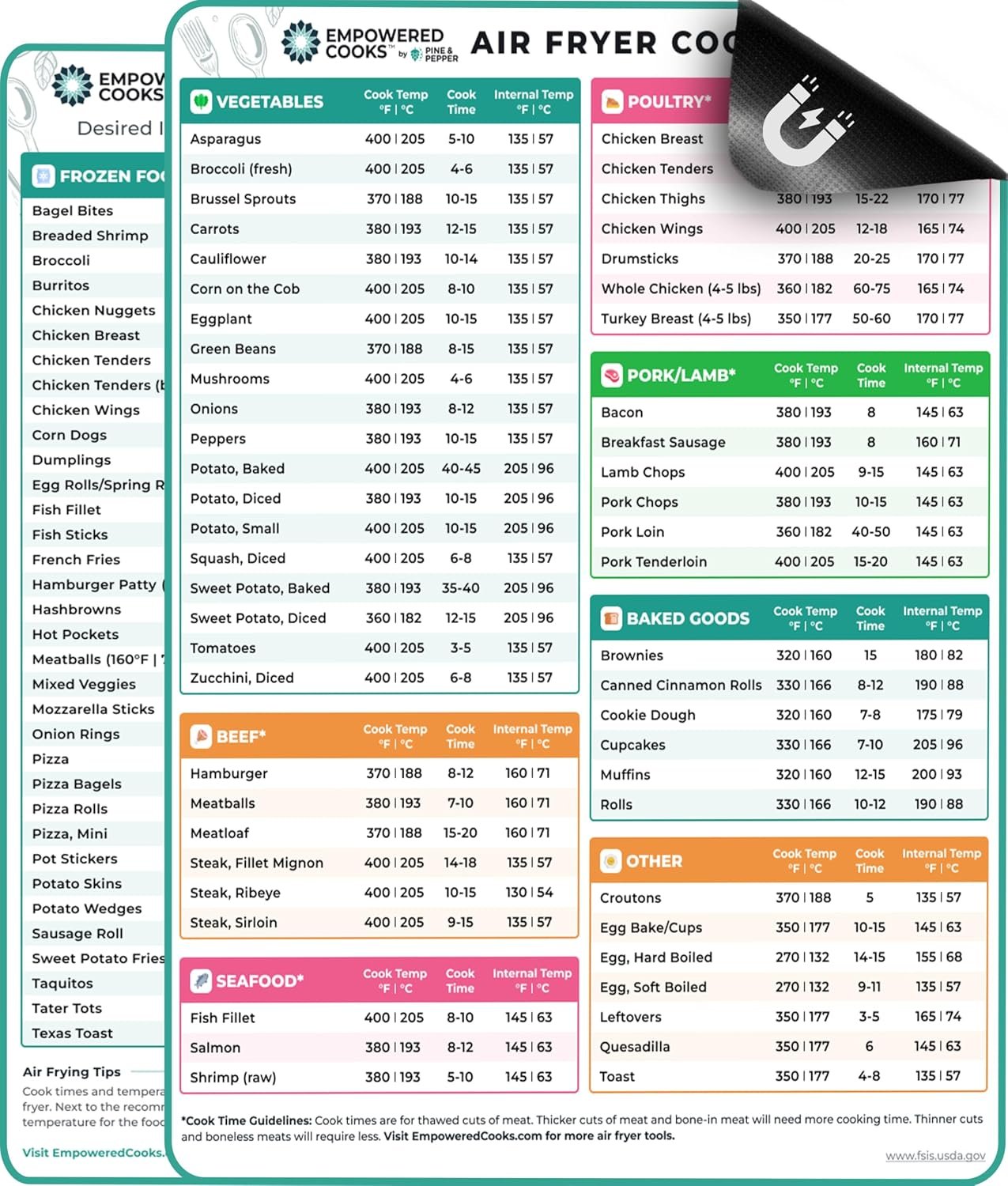
Air fryers are often simple to operate, but deciding how long to cook a particular food and what temperature to use can take some trial and error. A cooking chart can be especially useful when preparing an ingredient for the first time, adapting a conventional oven recipe, or trying to remember the recommended internal temperature for meat and poultry.
Cathy Yoder’s Air Fryer Cheat Sheet Set is designed as a countertop cooking reference for these situations. Rather than functioning as a cooking appliance itself, the set provides quick-reference information intended to help air fryer users estimate cooking times, temperatures, and internal food temperatures for a wide range of commonly prepared foods.
The product is marketed as a magnetic air fryer cheat sheet and cook-times chart, with information covering more than 80 popular foods. The reference material includes cooking temperatures, approximate cooking times, and internal food-temperature information. The magnetic format is designed to allow the charts to be placed on a refrigerator, metal appliance, or another suitable magnetic surface where they can remain visible during meal preparation.
This type of accessory addresses a simple problem: air fryer recipes are not always consistent from one appliance to another. Basket size, heating power, airflow, food quantity, starting temperature, and ingredient thickness can all affect how quickly food cooks. A reference chart can provide a starting point, but it should not replace checking the food itself.
Internal temperature information is particularly important for meat, poultry, and other foods where visual appearance alone may not reliably indicate doneness. A chart can tell the cook what temperature to aim for, while a properly used food thermometer provides a way to verify the temperature in the actual food.
The Cathy Yoder Air Fryer Cheat Sheet Set can therefore be viewed as a convenience and reference accessory rather than a substitute for recipes, food-safety guidance, or the instructions supplied with an individual air fryer.
This guide explains what the cheat sheet set offers, how it can be used in everyday cooking, who may find this type of accessory useful, and what limitations should be considered when relying on cooking charts.
Key Features
Magnetic Cooking Reference
One of the defining characteristics of the set is its magnetic format.
Instead of keeping a paper cooking chart inside a drawer or searching through a cookbook each time an ingredient needs to be prepared, a magnetic reference can be placed somewhere visible and accessible.
Suitable locations may include:
- A refrigerator door
- A magnetic side panel of an appliance
- A magnetic kitchen board
- Another clean, dry magnetic surface
The advantage is primarily convenience.
The chart can remain available while preparing food, which can make it easier to check a temperature or approximate cooking time without stopping to search through another source.
A magnetic reference is also relatively easy to move. If the kitchen arrangement changes, the chart can be repositioned.
Information for More Than 80 Foods
The product is described as covering more than 80 popular foods.
A broad selection is useful because air fryers are commonly used for much more than frozen fries.
A comprehensive reference can include different categories of foods such as:
- Vegetables
- Potatoes
- Chicken
- Beef
- Pork
- Seafood
- Frozen foods
- Breakfast foods
- Snacks
- Other everyday ingredients
The exact foods and entries should be confirmed against the current product packaging or listing.
The broader the selection of ingredients covered by a chart, the more frequently it may be useful in a kitchen.
However, a chart covering many foods should still be treated as a general reference. Individual ingredients can differ significantly in size, thickness, moisture, preparation, and starting temperature.
Cooking Time Reference
Cooking time is one of the most useful pieces of information for an air fryer beginner.
Someone preparing chicken wings, vegetables, salmon, or frozen snacks for the first time may have no idea where to start.
A cheat sheet provides an approximate time range that can serve as an initial reference.
For example, a chart might indicate that a particular food generally requires a certain number of minutes at a specified temperature.
The user can then monitor the food and make adjustments based on actual cooking progress.
This is important because cooking charts are not precise timers for every appliance.
A particular air fryer may cook somewhat differently from another model. Basket size, fan strength, heating elements, and food placement all matter.
Temperature Reference
Cooking temperature is another central part of an air fryer recipe.
Air fryers can operate across a relatively wide range of temperatures, but different foods require different approaches.
A temperature reference can help users distinguish between lower-temperature cooking, moderate roasting, and higher-temperature crisping.
The chart may be particularly useful for beginners who are not yet familiar with the temperature settings on their appliance.
Instead of guessing whether a food should be prepared at 325°F, 375°F, or 400°F, the user can consult a reference and then adjust as necessary.
Internal Food Temperature Information
The inclusion of internal food temperatures is particularly important.
For meat and poultry, the outside appearance of food does not always provide enough information to determine whether it has been cooked safely.
An internal temperature chart provides a reference for target temperatures.
However, there is an important distinction between a temperature recommendation and a temperature measurement.
The cheat sheet can tell the cook what internal temperature to look for, but a food thermometer is required to measure the actual internal temperature.
This makes the internal-temperature portion of the chart most useful when paired with an appropriate kitchen thermometer.
Quick-Reference Format
A cheat sheet is designed to be consulted quickly rather than read from beginning to end.
This is useful when cooking because users often need one specific piece of information.
For example:
“What temperature should I start with?”
“Approximately how long should this food cook?”
“What internal temperature should chicken reach?”
A well-organized reference chart puts those answers in a format that can be checked quickly.
This can be particularly helpful during busy meal preparation.
Designed for Air Fryer Cooking
Air fryer cooking differs from conventional oven cooking.
Hot air circulates around the food, and the relatively compact cooking chamber can heat food differently from a large oven.
A dedicated air fryer reference chart is therefore designed around the types of cooking decisions air fryer users commonly face.
It can provide a starting point for foods that are frequently prepared using circulating hot air.
Still, users should not assume that an air fryer chart automatically applies to every model.
Kitchen-Friendly Accessory
Unlike a physical cooking appliance, the cheat sheet requires virtually no setup.
It does not need electricity, charging, batteries, or a cooking cycle.
Its main purpose is to remain accessible while the air fryer is being used.
This makes it a relatively simple accessory for a kitchen that already has an air fryer.
How It Can Be Used
Starting a New Air Fryer Recipe
One of the most straightforward uses is as a starting reference when preparing a food for the first time.
Suppose someone wants to cook fresh broccoli but has never prepared it in an air fryer.
Instead of guessing at both temperature and cooking time, the user can consult the chart for an approximate starting point.
The food can then be monitored during cooking and adjusted if necessary.
This approach is generally more practical than treating the listed time as an absolute guarantee.
Cooking Frozen Foods
Air fryers are frequently used for frozen foods.
Examples include:
- French fries
- Tater tots
- Chicken nuggets
- Breaded fish
- Frozen vegetables
- Mozzarella sticks
- Hash browns
- Other frozen snacks
A cooking chart can provide an initial temperature and time range.
However, package instructions should also be considered.
Different frozen products can have very different sizes and compositions, even when they belong to the same general category.
A thin frozen potato product may cook differently from a thick-cut version.
Preparing Chicken
Chicken is an area where cooking time and internal temperature are both useful.
A chart can provide an approximate air fryer temperature and cooking duration, while the internal temperature information can help determine when the chicken is adequately cooked.
This is particularly relevant for:
- Chicken breasts
- Chicken thighs
- Chicken wings
- Drumsticks
- Chicken tenders
- Breaded chicken
Thickness can make a major difference.
Two chicken breasts of different sizes may require different cooking times even if they are cooked at the same temperature.
For this reason, the chart’s internal-temperature information should be used alongside an actual thermometer.
Cooking Beef
Air fryers can also be used for certain beef preparations.
Examples include:
- Steak
- Burgers
- Meatballs
- Small beef portions
Internal temperature can be especially important when preparing beef because the desired level of doneness varies.
A reference chart can provide target temperatures, but the user should determine the actual internal temperature with a thermometer when appropriate.
Preparing Pork
Pork can also be prepared in an air fryer.
Depending on the cut, users may prepare:
- Pork chops
- Pork tenderloin
- Small pork portions
- Bacon
- Sausage
Cooking times can vary substantially between these foods.
A reference chart can help users establish a starting point while the internal-temperature guidance provides an additional safety reference.
Cooking Fish and Seafood
Fish can cook relatively quickly in an air fryer.
Salmon, white fish fillets, shrimp, and other seafood can be prepared using suitable settings.
A cooking chart can help users estimate the initial cooking duration.
Because seafood can dry out when overcooked, checking food earlier than the maximum suggested time can be useful.
Preparing Vegetables
Vegetables are another common air fryer category.
The cheat sheet can serve as a quick reference for vegetables such as:
- Broccoli
- Cauliflower
- Brussels sprouts
- Zucchini
- Carrots
- Asparagus
- Bell peppers
- Green beans
- Sweet potatoes
Preparation affects cooking time.
A whole carrot will cook differently from thin carrot sticks, and large broccoli florets behave differently from finely chopped pieces.
The chart therefore works best as a starting point.
Cooking Potatoes
Potatoes are among the foods most frequently associated with air frying.
Users may prepare:
- French fries
- Potato wedges
- Cubed potatoes
- Sweet potato fries
- Hash browns
- Tater tots
Cooking time can vary depending on whether the potatoes are fresh or frozen and how thickly they are cut.
The chart can help establish an initial temperature and duration.
For fresh potatoes, a small amount of oil may also be used depending on the recipe.
Preparing Breakfast Foods
An air fryer can be useful for breakfast foods such as bacon, sausage, hash browns, and other suitable items.
A quick-reference chart can be convenient during morning meal preparation because users may not want to search through a full recipe collection before starting a simple food.
Different breakfast foods can also have very different cooking requirements, making a reference chart useful for quick comparisons.
Reheating Food
Some air fryer users primarily use their appliance for reheating leftovers.
A reference guide can provide starting points for foods such as pizza, chicken, roasted vegetables, and other leftovers.
Reheating generally requires less time than cooking raw food, so users should pay attention to the food rather than relying solely on a chart designed for full cooking.
Planning Multiple Foods
A chart can also be useful when planning a meal involving several foods.
For example, someone preparing chicken and vegetables may consult the chart to estimate how long each component needs.
This information can help determine which food should begin first.
The chart does not need to provide an exact synchronized schedule. It simply gives the cook useful reference points for planning.
Who It May Be Suitable For
New Air Fryer Users
Beginners may find a cheat sheet particularly useful.
When someone first purchases an air fryer, even simple questions can arise:
- What temperature should I use?
- How long should this cook?
- Should I check it halfway through?
- What internal temperature should meat reach?
A reference chart can provide a starting framework.
This can make the learning process less dependent on guessing.
Busy Home Cooks
People who cook regularly may appreciate having commonly used information immediately available.
Instead of repeatedly searching online for basic cooking times, a magnetic chart can remain in the kitchen.
The convenience becomes especially relevant when preparing familiar foods that do not require a full recipe.
Families
In a family kitchen, different people may use the air fryer.
A visible cooking reference can make basic information accessible to multiple household members.
This can be useful when teenagers or other family members are learning to prepare simple meals.
However, basic food-safety practices should still be explained rather than assuming a chart alone is sufficient.
People Learning Air Fryer Cooking
Someone transitioning from conventional oven cooking to air frying may need to learn new cooking times and temperatures.
An air fryer-specific chart can serve as a bridge between the two methods.
It can provide a starting point while users learn how their particular appliance behaves.
People Who Frequently Cook Without Recipes
Some home cooks prepare simple meals without following a complete recipe.
For them, a quick-reference chart can provide useful guidance without requiring a detailed recipe for every ingredient.
The chart can answer basic temperature and timing questions while leaving room for the cook to season and prepare food according to personal preferences.
Meal-Prep Users
People preparing several portions at once can use cooking-time information to plan their workflow.
For example, a user might prepare chicken in one batch and vegetables in another.
Knowing approximate cooking durations can help organize the process.
The actual cooking time should still be adjusted according to quantity and food arrangement.
Important Things to Consider
A Cooking Chart Is a Starting Point
One of the most important things to understand about any air fryer cheat sheet is that the listed times are estimates.
Air fryers differ in:
- Wattage
- Basket size
- Fan design
- Heating elements
- Cooking chamber geometry
- Airflow
- Food capacity
Even two air fryers with the same stated capacity can produce different cooking results.
The chart should therefore be treated as a starting reference rather than a guarantee.
Food Size Changes Cooking Time
Ingredient size can have a major impact.
For example, a thin chicken tender and a thick chicken breast should not be expected to require identical cooking times.
The same principle applies to:
- Potato pieces
- Fish fillets
- Vegetables
- Burgers
- Meatballs
- Frozen snacks
Whenever possible, consider both the chart and the physical characteristics of the food.
Starting Temperature Matters
Food taken directly from a refrigerator can cook differently from food that has been sitting at room temperature.
Frozen food can behave differently from refrigerated food.
This is another reason why cooking charts should not be treated as exact timers.
Don’t Rely on Color Alone
Color and texture can provide useful clues, but they are not always enough to determine whether meat or poultry has reached a safe internal temperature.
For foods where internal temperature matters, use a food thermometer.
The chart can provide the target reference; the thermometer provides the measurement.
Internal Temperatures Should Be Used Correctly
When measuring meat or poultry, the thermometer should be inserted into the appropriate part of the food rather than simply touching the surface.
For thicker foods, checking the center is generally more informative than checking only the exterior.
Users should follow reliable food-safety guidance for thermometer placement and safe temperatures.
Avoid Treating the Chart as a Recipe Book
A cheat sheet is primarily a reference tool.
It may tell you that a certain ingredient can be cooked at a particular temperature for an approximate amount of time, but it may not provide the complete recipe.
Seasoning, preparation, marinades, oil quantity, cutting technique, and serving instructions may still need to come from another source.
Check Your Air Fryer’s Manual
The manufacturer’s instructions for the air fryer should remain an important reference.
The manual can contain information about:
- Maximum capacity
- Suitable cookware
- Temperature limits
- Cleaning
- Safety
- Basket positioning
- Preheating
- Recommended cooking methods
A third-party chart should not override the appliance manufacturer’s safety instructions.
Consider the Physical Placement
Because the chart is magnetic, it needs an appropriate surface.
Not every refrigerator door or appliance side is magnetic.
Before relying on a permanent placement, make sure the surface is suitable and the chart remains dry and readable.
Keep the Chart Clean
Kitchen environments can involve steam, oil, sauces, and food splashes.
A visible reference chart can become dirty if it is positioned too close to active cooking.
Keeping it in an accessible but protected location can help preserve readability.
Comparison of General Air Fryer Reference Categories
Air fryer cooking information is available in several formats, and each has a different role.
Magnetic Cheat Sheets
Magnetic charts are designed for quick access.
They can remain visible in the kitchen and can be checked without opening a cookbook or searching on a phone.
The Cathy Yoder set fits into this category.
Its main purpose is convenience and quick reference.
Printed Cookbooks
Cookbooks generally provide more detailed information.
A cookbook may include:
- Full recipes
- Ingredient quantities
- Preparation instructions
- Cooking methods
- Serving suggestions
- Variations
The tradeoff is that finding one specific temperature or cooking time can take longer than looking at a compact cheat sheet.
A cookbook and cheat sheet can therefore complement each other.
Recipe Cards
Recipe cards are useful for specific meals.
They can provide detailed instructions for one recipe but generally cover fewer foods than a broad cooking chart.
A cheat sheet is more useful for general reference across many ingredients.
Mobile Apps
Air fryer apps and recipe websites can provide extensive information and may include photographs, step-by-step instructions, user adjustments, and search functions.
Their main limitation is dependence on a phone, tablet, or internet connection in some cases.
A physical magnetic chart can provide basic information without requiring a screen.
Digital Notes
Some users simply keep cooking times in a phone note.
This is flexible and customizable, but it requires opening the device and navigating to the information.
A physical reference can be faster for simple, repeated questions.
Food Thermometers
A food thermometer serves a different purpose.
It does not tell the cook how long a food should be cooked before starting. Instead, it measures the food’s actual internal temperature.
For meat and poultry, a thermometer is an important complement to a cooking chart.
The two tools serve different roles:
Cheat sheet: provides an estimated cooking time and temperature.
Thermometer: measures actual internal temperature.
Using both can provide more useful information than relying on either one alone.
Practical Ways to Use the Cheat Sheet
Use It Before Starting
Check the approximate temperature and cooking time before placing food into the air fryer.
This gives you a starting plan.
Check the Food Before the Listed Time Ends
If the chart provides a range, begin checking toward the earlier part of that range.
This is particularly useful with smaller pieces of food.
Adjust for Quantity
If you double the amount of food, do not automatically assume that the cooking time should simply be doubled.
Air circulation and basket space affect cooking.
A crowded basket can require a different approach.
Adjust for Thickness
Thicker foods generally need more time than thinner pieces.
If your ingredient is significantly larger than the type described by the chart, use the listed information as a reference rather than a strict instruction.
Shake or Turn When Appropriate
Some foods benefit from redistribution.
French fries, vegetables, and small frozen foods may cook more evenly when shaken.
Larger pieces may benefit from being turned.
Use the Internal Temperature Reference
When cooking meat, poultry, or other foods where internal temperature matters, consult the target temperature information and verify the actual temperature with a thermometer.
Keep Your Most-Used Information Accessible
If certain foods are prepared regularly, placing the chart somewhere easy to see can save time.
A refrigerator door or another suitable magnetic surface can make the information available while planning meals.
Frequently Asked Questions
What is Cathy Yoder’s Air Fryer Cheat Sheet Set?
It is a cooking reference accessory designed for air fryer users. The set provides information about cooking temperatures, approximate cooking times, and internal food temperatures for more than 80 popular foods.
Is the cheat sheet a recipe book?
No. It is primarily a quick-reference cooking chart.
It provides basic information such as temperatures and approximate times rather than serving as a complete collection of detailed recipes.
How many foods are included?
The product is described as covering more than 80 popular foods.
The exact food list should be checked against the current product packaging or Amazon listing.
What information does the chart provide?
The product is designed to provide air fryer cooking times, temperature guidance, and internal food-temperature references.
Is the chart magnetic?
Yes. The product is designed as a magnetic air fryer cooking reference.
It can be placed on a suitable magnetic surface in the kitchen.
Where can I put the magnetic chart?
Potential locations include a refrigerator door, magnetic appliance surface, or another suitable magnetic area.
The surface should remain dry and accessible.
Does the chart work with any air fryer?
The chart is intended as a general air fryer cooking reference rather than a model-specific guide.
Because air fryers vary, the listed cooking times should be treated as starting points.
Always consider the instructions supplied with your particular air fryer.
Are the cooking times exact?
No.
Cooking times should be considered approximate because ingredients, quantities, appliance design, airflow, food thickness, and starting temperature can all affect the result.
Can beginners use this chart?
Yes. A quick-reference chart can be particularly useful for people learning basic air fryer cooking.
It can provide a starting temperature and approximate cooking time without requiring users to search for a recipe every time.
Does the chart include internal food temperatures?
Yes. Internal food-temperature information is one of the features described for the product.
This information is particularly relevant when cooking meat and poultry.
Do I still need a food thermometer?
For foods where internal temperature is important, a food thermometer remains useful.
The chart provides a target or reference, while the thermometer measures the actual temperature inside the food.
Can I use the chart for frozen food?
Yes, the chart is intended to cover a wide range of popular foods, including common air fryer applications.
However, frozen foods can vary considerably by brand, size, and preparation, so package instructions should also be considered.
Can the chart be used for vegetables?
Yes. Vegetable cooking is a common air fryer application, and a broad air fryer cooking reference can provide starting points for different vegetables.
Can it help with chicken?
Yes. A cooking chart can provide approximate temperature and timing information for chicken, while internal-temperature guidance can help with safe cooking.
Can it be used for steak?
It can provide general cooking guidance for steak.
Because steak thickness and desired doneness vary, actual internal temperature should be checked when appropriate.
Can it be used for fish?
Yes. Fish and seafood are common air fryer foods.
Because fish can cook relatively quickly, monitoring the food during the latter part of the recommended range is useful.
Does the cheat sheet replace the air fryer’s instruction manual?
No.
The air fryer manufacturer’s manual should remain the primary source for appliance-specific safety, operation, capacity, and maintenance instructions.
Does it replace recipes?
No.
A cheat sheet provides quick-reference information, while recipes provide detailed preparation instructions.
Can I use it without an internet connection?
Yes. Because it is a physical reference, the information is available without needing an internet connection.
Is a magnetic cheat sheet better than using a phone?
It depends on personal preference.
A phone provides access to a much larger amount of information, while a physical chart can be faster for repeatedly checking basic cooking times and temperatures.
Can the chart be used by the whole family?
Yes. A visible kitchen reference can make basic air fryer information accessible to different household members.
Food-safety guidance should still be explained to anyone who is learning to cook.
Is this useful for meal preparation?
It can be.
Knowing approximate cooking times for different foods can help users plan the order in which ingredients should be prepared.
Can I use the chart for every type of food?
The chart is designed to cover many common foods, but it will not necessarily contain every ingredient or recipe.
For foods not listed, users can consult other reliable cooking resources and their air fryer’s instructions.
Why can the same food have different cooking times in different air fryers?
Air fryers differ in wattage, basket shape, airflow, heating elements, and cooking-chamber design.
Food quantity and preparation also affect cooking time.
This is why chart times should be treated as estimates.
What should I do if my food is not cooked after the suggested time?
Continue cooking as appropriate while monitoring the food.
For meat and poultry, check internal temperature using a suitable food thermometer.
If food consistently requires significantly different cooking times, record the settings that work for your particular air fryer.
Conclusion
Cathy Yoder’s Air Fryer Cheat Sheet Set is designed as a simple reference accessory for people who want commonly used air fryer cooking information available in the kitchen.
Its magnetic format allows the chart to remain visible on a suitable magnetic surface, while the stated coverage of more than 80 popular foods gives it a broad range of potential applications. Rather than focusing on detailed recipes, the cheat sheet is centered on practical information such as approximate cooking times, temperature guidance, and internal food-temperature references.
That makes it particularly relevant for everyday questions.
A new air fryer user may want to know where to start when cooking vegetables, potatoes, chicken, fish, frozen foods, or other common ingredients. Someone who already uses an air fryer regularly may simply want a convenient reminder without searching through a cookbook or phone.
The internal-temperature information is especially useful when preparing meat and poultry, but it should be understood correctly. A chart can provide a target temperature, while a food thermometer is used to determine the actual internal temperature of the food.
The same principle applies to cooking times.
An air fryer chart cannot account perfectly for every appliance, food quantity, ingredient thickness, starting temperature, basket arrangement, or recipe. Different air fryers can produce different cooking results, even when the same temperature and time are selected. The chart is therefore most useful as a starting reference rather than a guarantee.
Compared with a cookbook, the magnetic cheat sheet emphasizes speed and convenience. Compared with a mobile recipe app, it provides physical information that does not require a screen or internet connection. Compared with a food thermometer, it serves a different purpose by providing cooking estimates rather than measuring the food itself.
For people who regularly prepare meals with an air fryer and want frequently used temperature and timing information within easy reach, a physical cooking reference can be a practical addition to the kitchen.
Used alongside the air fryer’s manufacturer instructions, reliable food-safety guidance, and a food thermometer when appropriate, the cheat sheet can help make everyday air fryer cooking more organized and predictable.
Leave a Reply